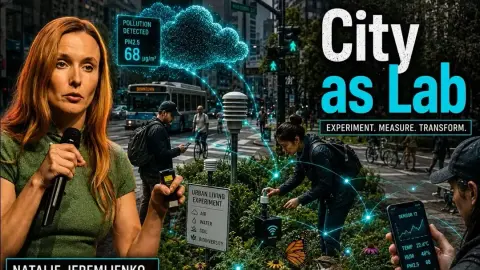
Natalie Jeremijenko
1966
Australian artist and engineer who turns the city into a laboratory: rather than denouncing environmental harm, she builds public experiments anyone can repeat.
Jeremijenko works from a simple idea: the urban environmental problem is not a lack of awareness but a lack of instruments. People cannot act on what they cannot measure. So she builds the instruments, puts them on the street and teaches people to use them — and she does it in the form of an artwork, so that people come closer instead of turning away.
Her most cited piece is the feral robotic dogs: cheap electronic toys bought in department stores and reprogrammed with pollutant sensors, which residents release onto a suspect vacant lot and follow as they sniff their way towards the source of the toxin. The data does not come from a consultancy or an agency: the neighbourhood produces it, and that makes it hard to ignore.
An Australian artist, engineer and professor born in 1966, Jeremijenko directs the xDesign Environmental Health Clinic at New York University, which works like a surgery in reverse: you book an appointment not for a symptom of your own but for an environmental worry, and instead of a prescription you leave with an action protocol and a borrowed device. She studied in Australia and worked at Xerox PARC.
OneTrees (1998) planted a hundred cloned, genetically identical trees in pairs across the San Francisco Bay Area and let them grow for years: the differences in size and health draw a map of air and soil that no report explains as well. Amphibious Architecture and the Mussel Choir took the method to water, with river sensors translating water quality into light and sound. Her work has defined much of what is now called citizen science.
Videos on Natalie Jeremijenko (1)
- Housing
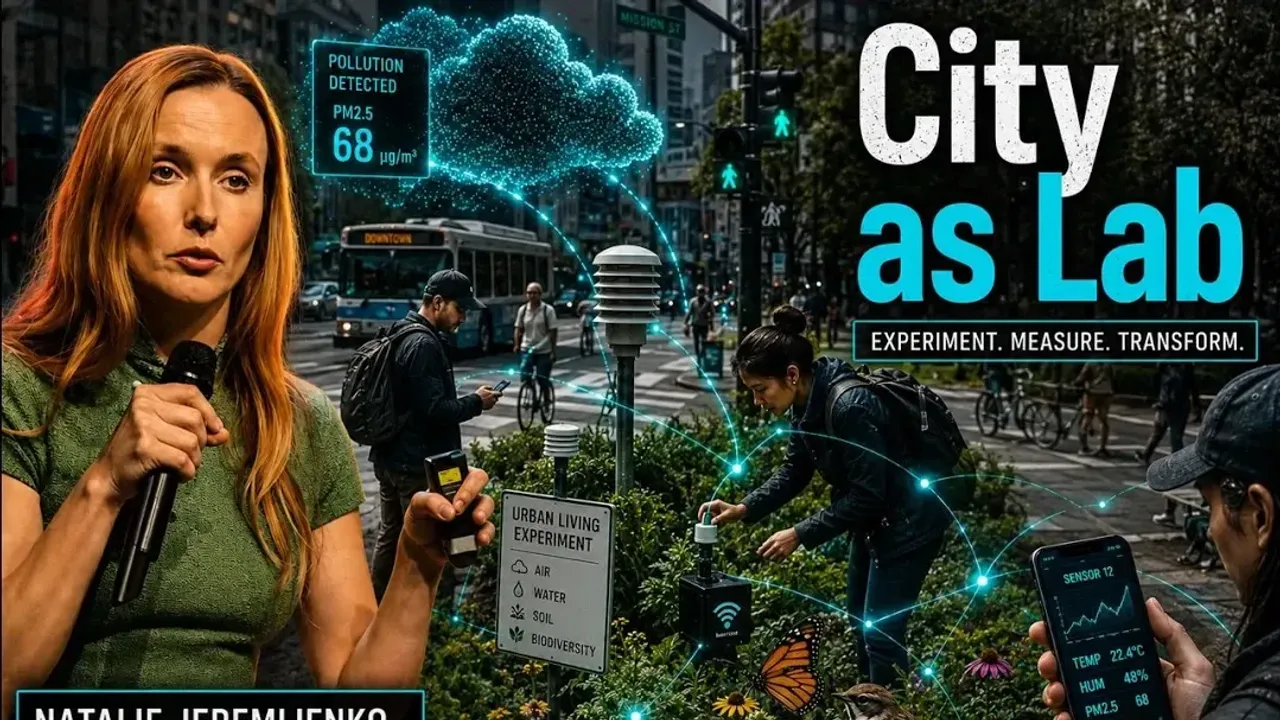
Natalie Jeremijenko: The City as a Participatory Ecology Lab
Natalie Jeremijenko's devices make pollution and urban biodiversity visible so citizens can investigate and act.…
Natalie Jeremijenko 3 min read