Susan Fainstein
1938
American political scientist who put justice at the centre of planning: equity, democracy and diversity as criteria for judging a city.
Born in 1938, awarded a doctorate at MIT and a professor at Rutgers, Columbia and Harvard, where she taught urban planning until her retirement, Fainstein first studied the large real estate projects of New York and London in The City Builders (1994), where she showed how 1980s planning put itself at the service of developers, and edited with Dennis Judd The Tourist City (1999), on cities remade for the visitor.
The Just City (2010) is her major work. Against planning that promises growth and theory that only denounces, she proposes judging urban policies by three criteria, equity, democracy and diversity, and applies them to New York, London and Amsterdam to conclude that Amsterdam, with its social housing and its control of land, is the fairest city of the three. Her inspiration is John Rawls, and her audience the planners who decide every day.
She has been one of the main voices of urban regime theory and of the critique of communicative planning, which she reproaches for trusting dialogue without looking at outcomes. Her question, just for whom, has become a criterion for evaluating urban projects around the world, and Searching for the Just City (2009), edited with Peter Marcuse and others, gathered the debate her work opened.
Videos on Susan Fainstein (1)
- Public space
Susan Fainstein's Just City: Equity, Diversity and Democracy
The Just City (2010) by Susan Fainstein proposes judging urban policy by its equity, diversity and democracy.
Susan Fainstein 3 min read
Where Susan Fainstein is cited (4)
- Urban form
John Forester: Dialogue and Mediation for Inclusive Urban Planning
John Forester explains what planners do among conflicting interests and how dialogue and mediation produce fairer…
John Forester 2 min read - Urban economy
Critical Urban Studies by Davies and Imbroscio: Social Justice
Critical Urban Studies (2010), edited by Jonathan Davies and David Imbroscio, revisits urban studies from social…
2 min read - Public space
Spatial justice: what it is, after Soja and Fainstein
What spatial justice is and how Edward Soja (Seeking Spatial Justice) and Susan Fainstein (The Just City)…
2 min read - Public space
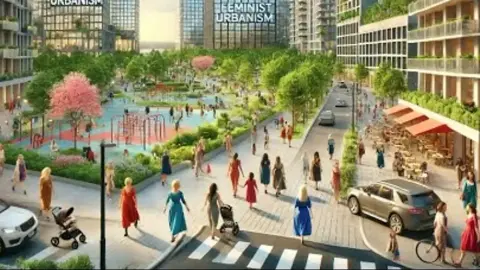
Feminist Urbanism: What It Is, Principles and City Examples
Feminist urbanism designs cities for daily life and care work, not for the man with a car. What Jane Darke and…
3 min read