Planning with a gender perspective is not about making cities for women. It is about no longer designing them for an imaginary inhabitant who travels from home to work in the morning and back in the afternoon, accompanying nobody, carrying nothing and afraid at no hour. That inhabitant exists, but is a minority, and for a century was the only one who appeared in the plans.
This guide gathers what research and city practice know about it: how people who care for others actually move, why safety is not solved with cameras, what Vienna and Barcelona have built, how to run participation that is not a formality, and which indicators show whether a plan has changed anything.
The inhabitant who never existed
Twentieth-century functionalist planning separated the city into zones: you live here, work there, shop somewhere else. That scheme is only convenient for someone making one outward and one return trip, by car and with no obligations in between. Strict zoning and the residential suburb were conceived, without saying so, for a household with one wage earned outside and one person inside taking care of everything else.
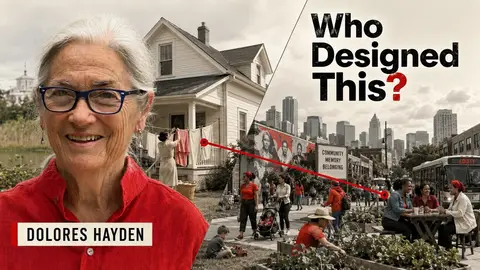
When that person also works outside, the scheme stops working and she pays the cost. Dolores Hayden documented this in What Would a Non-Sexist City Be Like? (1980) and The Grand Domestic Revolution (1981): the American suburb was not a neutral way of building but a spatial organisation of unpaid domestic work.
In Europe, the Viennese Frauen-Werk-Stadt initiative and the Catalan groups Col·lectiu Punt 6 and Equal Saree have shown the same in dense cities. The problem is not density but single use: a district where people only sleep forces travel for everything, and those who travel most because of someone else's needs are those who do the caring.
Care mobility: the trips surveys do not count
Classic mobility surveys count trips by main purpose, and the star purpose is work. That makes care trips disappear statistically: the school run, the pharmacy, the shopping, visiting an elderly relative, collecting, accompanying. Inés Sánchez de Madariaga proposed naming and counting them separately with the concept of care mobility, now incorporated into official surveys in Spain and several European countries.
Counted separately, four features emerge. They are chained trips, several short stops in a row, not one outward journey. They are multipurpose: you travel accompanying someone and carrying something. They are local, within the district or between neighbouring ones, not radial towards the centre. And they are made mostly on foot and by public transport, outside peak hours.
The fare consequence is concrete and almost never corrected: a system charging per trip penalises someone making five short ones against someone making one long one, and a season ticket designed for the commute is useless to someone travelling mid-morning. Free transfers over a generous window and zonal rather than per-trip tickets are the technical answer.
Safety: what works and what merely reassures
Fear in public space is not evenly distributed: it limits the hours, routes and transport modes of part of the population, and that is a real cost even where crime statistics are low. What matters is not only what happens, but what people avoid doing in case it does.
What the evidence supports is simple and unspectacular: people on the street, what Jane Jacobs called eyes on the street; mixed uses so there is activity at different hours; active ground floors instead of blank walls and garage doors; visibility, with no recesses or planting that blocks sightlines at eye level; even lighting aimed at the pavement and at faces, not only at the carriageway; and alternative routes, because a single possible path is a trap.
What works less well than believed is cameras, which displace crime more than they reduce it and do not improve the feeling of safety if the place remains empty. Exploratory walks, in which a group of women walk the district at night and mark the specific points they avoid, remain the cheapest and most reliable method for knowing where to act, and are the signature tool of Col·lectiu Punt 6.
Vienna: thirty years of sustained policy
Vienna is the best-documented case because it has been doing the same thing without interruption since 1991. The city created a dedicated office and put its projects through gender review, starting small: an analysis of park use revealed that from the age of nine girls stopped going, and the subsequent redesign divided the space, added entrances and offered varied activities instead of one central pitch.
The flagship project is Frauen-Werk-Stadt, a 1997 housing complex designed by women architects, with a nursery, a pharmacy and a doctor's surgery inside the complex, courtyards visible from the kitchens, wide well-lit staircases instead of dark landings, and bike and pram storage next to the entrance rather than in a remote basement.
The lesson Vienna repeats is procedural, not architectural: what changed things was not an exemplary building but requiring every municipal project, from a bus stop to a local plan, to answer in writing who will use it and under what conditions. More than sixty pilot projects later, that step is administrative routine.
Barcelona and superblocks: proximity as policy
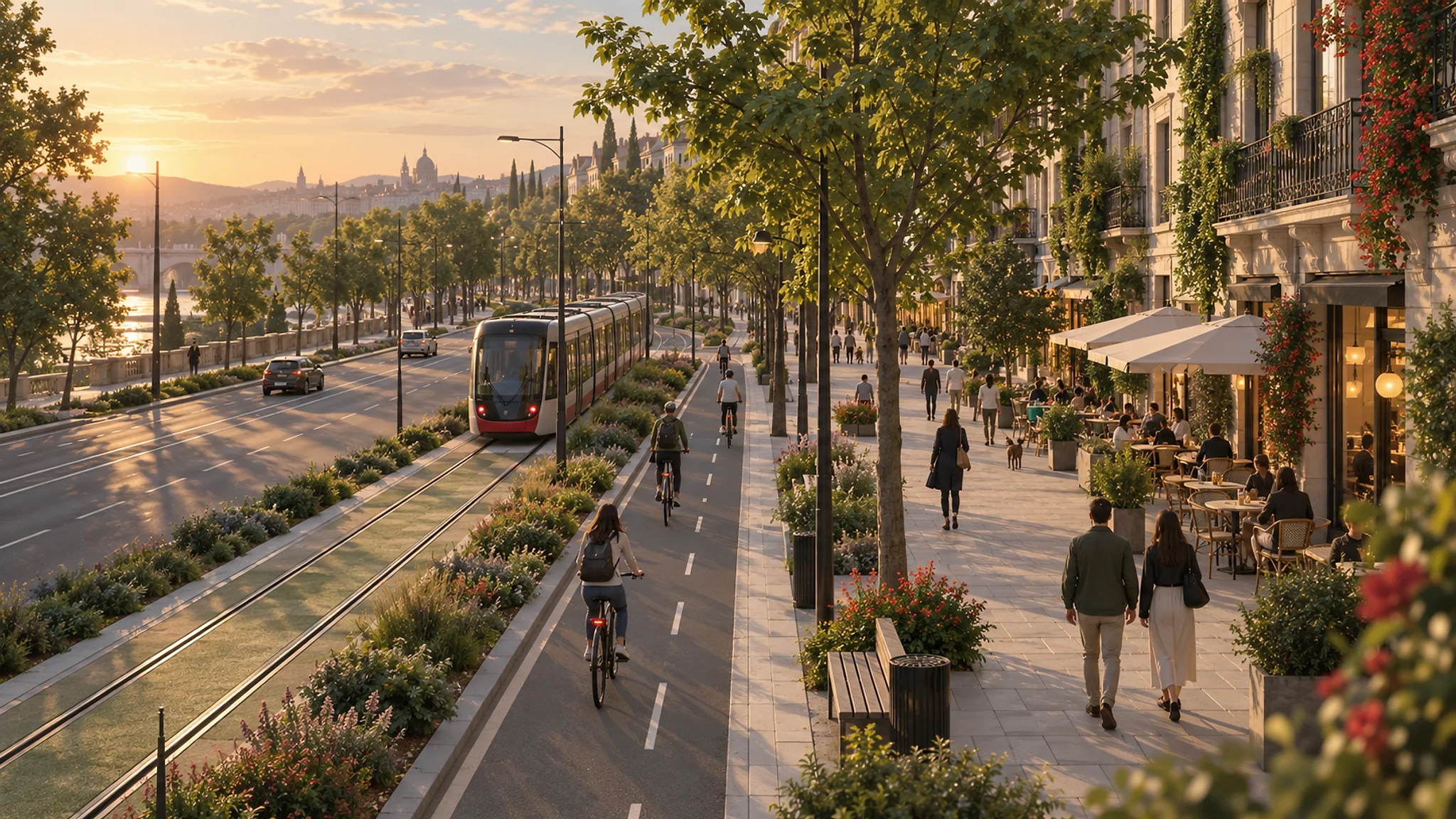
Barcelona has worked the same idea from another direction, that of proximity. The superblock groups several Eixample blocks and pushes through traffic to its perimeter, leaving the interior for sitting, playing, terraces and walking. The intended effect is not only environmental: it is that everyday activities can be resolved within walking distance.
The city has added specific tools: safe school routes, the urbanism of care in its neighbourhood plan, a review of street lighting using perception criteria rather than lux alone, and a network of support points at festivals and nightlife venues. Col·lectiu Punt 6 has taken part in many of those processes.
There are also well-founded criticisms worth keeping in mind. Transforming a street makes it more attractive and can make it more expensive, so without simultaneous housing policy the improvement ends up benefiting whoever arrives later. And the superblock works well on a regular grid like the Eixample, but does not transfer unchanged to irregular or low-density fabrics.
Participation: how not to run a formality
Sherry Arnstein's ladder of participation, published in 1969, remains the best tool for judging a process. Its bottom rungs are manipulation and therapy, which are non-participation; the middle ones are informing, consultation and placation, where people speak and someone else decides; and the top ones are partnership, delegated power and citizen control. Most municipal processes stop at the middle rungs and are presented as if they were at the top.
The practical test is simple: ask which part of the decision is genuinely open, and what happens if the outcome displeases the council. If the answer is that you get to choose the colour of the benches, it is information in disguise. If there is an assigned budget and a commitment to carry out what is decided, it is participation.
There is also an inequality in who can take part at all. A meeting at eight in the evening, with no childcare, lasting two hours and conducted in technical language, selects its attendees before it begins. The measures that correct this are known and cheap: varied times, childcare, short sessions, plain language, going to the neighbourhood instead of waiting at the town hall, and working with the associations that already exist.
How to check that something has changed
Without indicators, a gender perspective stays a declaration. Those that work best are concrete: the share of care trips in the mobility survey and its breakdown by sex; walking time from each doorway to school, health centre, market and park; the percentage of active ground floors per street; the level and evenness of pavement lighting; park use by age and sex at different hours; and the presence of women in public space at night.
Much of that data is already collected, but not disaggregated by sex and age, which is precisely what makes it useful. The minimum rule for any plan that wants to call itself gender-aware is that every piece of data collected about people is disaggregated, and published.
Finally, two frequent errors are worth avoiding. The first is treating women as a homogeneous group: an older woman with reduced mobility, a teenager and a night-shift worker do not experience the city in the same way. The second is reducing the gender perspective to safety: the bulk of the problem is about time, distance and the division of unpaid work, and it is solved with proximity, services and transport, not only with street lamps.
Frequently asked questions
- What is gender-aware urban planning?
- A way of planning that starts from the fact that the city is used differently depending on care work, age and perceived safety, and designs accordingly. It is not about making cities for women, but about no longer designing them only for the commute by car.
- What is care mobility?
- The set of trips made to look after other people or sustain a household: the school run, shopping, accompanying someone, going to the pharmacy. They are short, chained, local and outside peak hours, and classic surveys did not count them.
- Which measures genuinely improve safety?
- People on the street, mixed uses, active ground floors, visibility without recesses, lighting aimed at the pavement, and several possible routes. Cameras help little if the place stays empty. Residents' exploratory walks identify where to act better than any report.
- What is Arnstein's ladder?
- A 1969 classification with eight rungs running from manipulation to citizen control, used to judge whether a participatory process really shares power or merely informs. The practical test is to ask which part of the decision is genuinely open.
- Which city is the reference?
- Vienna, for continuity: since 1991 it has systematically reviewed its projects against gender criteria, from parks to the Frauen-Werk-Stadt housing complex. What makes it exemplary is not a building but having turned that review into a compulsory step.