James Scott
1936-2024
American political anthropologist who explained why the state's grand plans fail: to govern you must simplify, and the simplification destroys what held the place together.
The thesis of Seeing Like a State (1998) is that the modern state can only administer what it has first made legible: land registries, fixed surnames, uniform weights and measures, numbered streets on a grid. That simplification is useful and often necessary. The disaster comes when the map is mistaken for the territory and reality is redesigned to fit the map.
Scott called that faith «high modernism», and named the four conditions that make it lethal: the ambition to remake everything, a state powerful enough to do it, a civil society unable to resist, and the discrediting of local knowledge. Brasília, Soviet collectivisation and Tanzania's villagisation are his examples. Against them he defended mētis, the practical knowledge acquired only by doing, which no manual captures.
Born in New Jersey in 1936 and dead in 2024, Scott taught political science and anthropology at Yale, where he directed the Agrarian Studies Program for decades. His fieldwork in Malaysia produced Weapons of the Weak (1985), the book that showed peasants almost never revolt but always resist: they feign incomprehension, work slowly, pilfer, spread rumours. Domination and the Arts of Resistance (1990) systematised this into the «hidden transcripts» that subordinates keep out of power's sight.
In The Art of Not Being Governed (2009) he argued that the upland peoples of Southeast Asia are not backward but deliberately fugitive: they chose crops, scripts and kinship forms that made them hard to tax. Against the Grain (2017) took the argument back to the first states. For anyone thinking about cities, Scott is the standing warning against the planning that erases a neighbourhood in order to manage it.
Videos on James Scott (1)
- Urban geopolitics
James Scott: Why the State's Grand Plans Fail
James C. Scott explains in Seeing Like a State why high modernist plans fail: legibility, Le Corbusier, Brasília…
James Scott 2 min read

Where James Scott is cited (1)
- Urban form
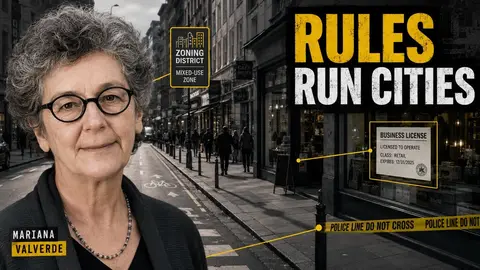
Mariana Valverde: How Small Rules Order Our City
Mariana Valverde shows that licences, zoning, regulations and policing produce urban order decision by decision.…
Mariana Valverde 3 min read