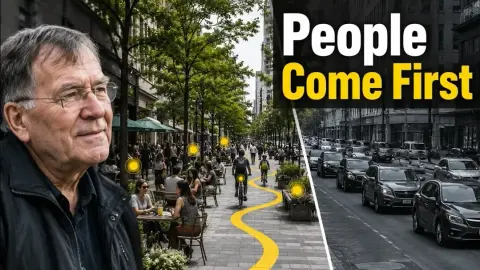
Jan Gehl
1936
Danish architect who started counting people instead of cars, and changed the look of Copenhagen and half of Europe.
Gehl did something unusual in the 1960s: he went out with a notebook and measured public life. How many pass, how many stay, where they sit, for how long. He found that optional activities — stopping, chatting, looking — only appear when the space is good, while necessary ones happen anyway.
Hence his practical rule: the city is designed at eye level and at five kilometres an hour, which is how it is perceived on foot. His work in Copenhagen, New York and Melbourne turned that observation into pedestrian streets, squares and bike lanes.
On Jan Gehl in this archive
- Public space
Walking Shapes a Safer and More Lively City
This article explains how walking influences urban design and creates safer, more lively cities. Urban planning…
Jan Gehl 3 min read - Mobility
Bicycle improves health and enhances neighborhood
Bicycling improves personal health and makes cities more livable. Discover how cycling benefits both individuals…
Jan Gehl 4 min read - Urban psychology
Urban Planning and Mental Health
Urban well-being and its impact on residents’ mental health has become an increasingly important topic in urban…
Jan Gehl 2 min read - Public space
Social Urbanism: Creating Inclusive and Cohesive Cities
Social urbanism is an approach to urban planning that focuses on social inclusion and the creation of public spaces…
Jan Gehl 3 min read - Public space
Pedestrianization: Creating More Livable and Sustainable Cities
Pedestrianization and the development of walkable spaces have become key strategies for improving quality of life…
Jan Gehl 2 min read