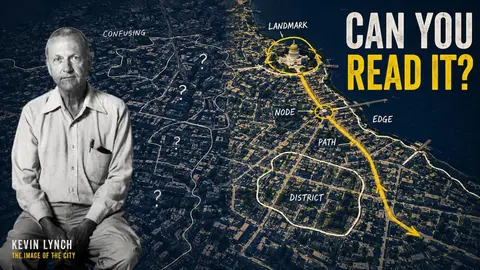
Kevin Lynch
1918–1984
American planner who asked people how they drew their city, and found that everyone uses the same five elements.
Lynch asked residents of Boston, Jersey City and Los Angeles to draw their city from memory. Out of that came paths, edges, districts, nodes and landmarks: the five pieces anyone builds a mental map with, and which explain why a city is understood or disorienting.
His concept of «legibility» turned something subjective into a verifiable design criterion. A legible city is not the prettiest or the tidiest: it is one where a stranger can place themselves, and that depends on having recognisable landmarks and clear edges, not on the quality of the façades.
Born in Chicago in 1918, Lynch studied with Frank Lloyd Wright at Taliesin before training as a planner at MIT, where he taught from 1948 until his death in 1984. The Image of the City (1960), the result of five years of interviews and mental maps in Boston, Jersey City and Los Angeles, identified the five elements people use to orient themselves, paths, edges, districts, nodes and landmarks, and defined legibility and imageability as qualities design can produce or destroy.
Site Planning (1962) was for decades the profession's handbook; What Time Is This Place? (1972) asked how the city shows and hides the passage of time; and Good City Form (1981) proposed five dimensions for judging any city: vitality, sense, fit, access and control. His mental map method is used today by signage, transport design and wayfinding programmes such as Legible London, and his insistence on asking residents anticipated participatory planning.
Videos on Kevin Lynch (1)
- Urban psychology
Kevin Lynch's The Image of the City: How We Perceive Cities
The Image of the City (1960) by Kevin Lynch explains how we perceive cities through five elements: paths, edges,…
Kevin Lynch 3 min read

Where Kevin Lynch is cited (1)
- Urban form
How Five Elements Make a City Legible and Accessible
Kevin Lynch's five elements, paths, edges, districts, nodes and landmarks, explain how people read a city, and…
3 min read