Matthew Gandy
1965
British geographer who studied nature in the city, from New York's water to the wild lots of Berlin.
Professor of geography at the University of Cambridge after two decades at University College London, where he founded the Urban Laboratory, Gandy is one of the main voices of urban political ecology and of the cultural geography of nature. Concrete and Clay (2002) reconstructed New York's environmental history through water, parks, Robert Moses's expressways and environmental justice in the Bronx, and showed that urban nature is always a political product.
The Fabric of Space (2014) followed water through six cities, Paris, Berlin, Lagos, Mumbai, Los Angeles and London, to compare how each built, privatised or let collapse its hydraulic infrastructure, with Lagos as the case where networked modernity never reached everyone. His work on the African city and on infrastructure as a field of power converses with Graham and Swyngedouw.
Natura Urbana (2022), accompanied by a documentary, studied the spontaneous vegetation of Berlin's vacant lots and wastelands, where postwar ecologists discovered new ecosystems, and proposed an urban ecology that values the wild against the designed nature of corporate parks. Gandy has also made films and written on sound, light and the urban night; his contribution is to have joined environmental history, critical theory and fieldwork.
Videos on Matthew Gandy (1)
- Urban ecology
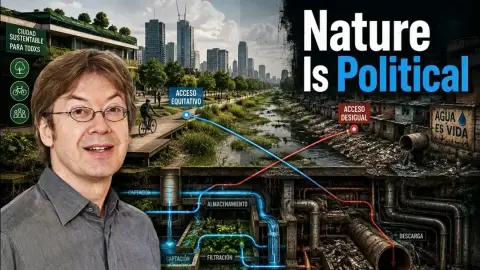
Matthew Gandy: Urban Nature Reveals Power in the City
Matthew Gandy shows that water, waste, parks and expressways are nature produced by political decisions: urban…
Matthew Gandy 3 min read
Where Matthew Gandy is cited (1)
- Urban geopolitics
Postcolonial Urban Fragmentation: Inequality and Resistance
Why postcolonial cities remain divided: Fanon's city, Graham and Marvin's splintering infrastructure, Caldeira and…
3 min read