Peter Calthorpe
1949
American architect who named transit-oriented development: dense, walkable neighbourhoods around each station instead of dispersed sprawl.
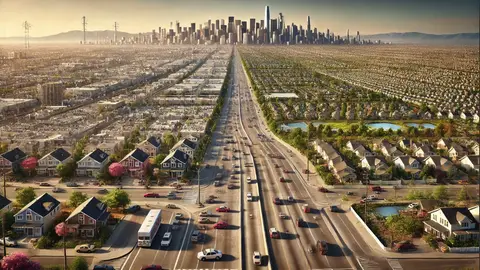
Calthorpe started from an engineering fact, not an aesthetic preference: the minimum density at which a transit line can support itself without permanent subsidy is known, and American sprawl is far below it. Hence transit-oriented development, TOD: concentrate housing, offices and shops within roughly a ten-minute walk of each station, and leave the rest at lower densities.
His contribution was turning that into a manual a city hall can apply. The Next American Metropolis (1993) does not stop at diagnosis: it sets radii, densities, street sections, use mixes and housing types. He had earlier coined the «pedestrian pocket», the compact neighbourhood unit beside the stop, which is the seed of the idea.
An American architect and planner born in 1949, Calthorpe was one of the founders of the Congress for the New Urbanism in 1993 and has led regional plans for Portland, Salt Lake City, Los Angeles and the state of California as a whole, as well as work in China and Abu Dhabi. With Sim Van der Ryn he had written Sustainable Communities (1986), one of the first books to join urban design and energy.
The Regional City (2001), with William Fulton, argued that the problem is not solved neighbourhood by neighbourhood but at metropolitan scale, where housing, transport and taxes are decided. Urbanism in the Age of Climate Change (2011) quantified the emissions saved by each urban option. He is fairly criticised for the fact that many developments labelled TOD end up as expensive estates next to a station, without the social mix the model promised.
Videos on Peter Calthorpe (1)
- Urban form
Peter Calthorpe and The Next American Metropolis: The Origin of TOD
The Next American Metropolis (1993) by Peter Calthorpe formulated transit-oriented development against the…
Peter Calthorpe 2 min read

Where Peter Calthorpe is cited (1)
- Urban form
The Horizontal City and Suburbanisation: Fishman and Hall on Sprawl
The horizontal city grows outward with low density, cars and highways. How Robert Fishman and Peter Hall explain…
3 min read