Richard Florida
1957
American urbanist who popularised the creative class as an economic engine and ended up writing the critique of his own idea.
Florida argued that cities no longer grow by attracting firms but by attracting people — designers, programmers, researchers — and that talent goes where there is tolerance, diversity and urban life. The thesis convinced hundreds of city halls, which rushed to build cultural districts and bike lanes.
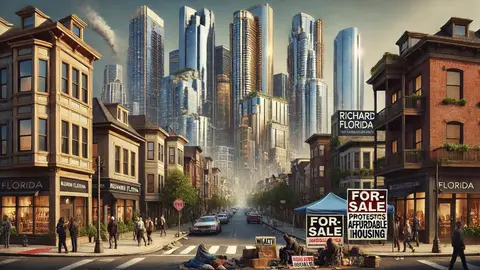
Fifteen years later he published the reckoning: those same policies concentrated wealth in a few neighbourhoods, drove housing prices up and pushed out those outside that class. His case is useful precisely for that: it shows what happens when an urban idea becomes a recipe.
An American urban theorist born in 1957, professor at the Rotman School of the University of Toronto and before that at Carnegie Mellon University, Florida became the most famous urbanist of his generation with The Rise of the Creative Class (2002), which argued that cities prosper when they attract scientists, engineers, designers and artists, and that such talent chooses places with technology, talent and tolerance. Cities and the Creative Class (2005) and Who's Your City? (2008) extended the thesis, and his consultancy, the Creative Class Group, sold it to hundreds of cities.
The critique came early: Jamie Peck described it in 2005 as fast policy without substance, Edward Glaeser showed that the effect vanished when education was controlled for, and Ann Markusen questioned the category itself. Florida answered with The New Urban Crisis (2017), where he acknowledged that the winning cities he had celebrated had become the most unequal and unaffordable, and proposed an urbanism for all. For all its flaws, his work forced cities to think about quality of life and openness as economic factors.
Videos on Richard Florida (2)
- Urban economy
Richard Florida and the Creative Class: What the Evidence Says
How Richard Florida measures the creative class with the three Ts and his indices, how it became fast policy and…
Richard Florida 3 min read - Urban economy
Richard Florida's The New Urban Crisis: Inequality in Cities
The New Urban Crisis (2017) by Richard Florida explains why the most prosperous cities push out the people who…
Richard Florida 2 min read

Where Richard Florida is cited (9)
- Urban economy
Why Some Cities Innovate and Others Do Not: Michael Storper
Michael Storper explains why some cities innovate and others do not: organisations, technologies and territories,…
Michael Storper 3 min read - Urban economy
Jamie Peck: Constructions of Neoliberal Reason and the City
Jamie Peck's Constructions of Neoliberal Reason explains neoliberalism as a process that finds its laboratory in…
Jamie Peck 2 min read - Urban ecology
Urban Energy Transition: Form, Ecological Footprint and Economy
The urban energy transition needs compact cities, lower consumption and renewables. What Peter Newman, William Rees…
3 min read - Urban economy
Triumph of the City by Edward Glaeser: Why Density Matters
Triumph of the City (2011) by Edward Glaeser argues that the dense city makes us richer, greener and healthier.
Edward Glaeser 3 min read - Urban economy
Creative Economy: Innovation or Inequality? Scott and Pratt
The creative economy drives urban innovation and distributes inequality. What Richard Florida, Allen J.
3 min read - Urban economy
Ann Markusen: Creative Economy, Artists and Urban Development
Ann Markusen measured what artists contribute to the urban economy, defined creative placemaking and criticised…
Ann Markusen 3 min read - Infrastructure
Urban Infrastructure and Competitiveness: Glaeser, Florida, Storper
Why urban infrastructure decides economic competitiveness: Glaeser on connecting people, Florida on talent, Storper…
2 min read - Urban economy
Innovation and Urban Development: Porter, Florida and Markusen
Innovation as the engine of urban development according to Michael Porter, Richard Florida and Ann Markusen:…
3 min read - Urban economy
Creative Urbanism: From Landry and Florida to Their Critics
Creative urbanism uses culture and art to regenerate cities. What Charles Landry and Richard Florida propose, what…
3 min read