William J. Mitchell
1944-2010
Australian architect who foresaw in 1995 the city made of information: networks do not replace urban space, they reorganise it and change its timetable.
Mitchell wrote City of Bits when the web was three years old, and he got the essential point right: the network was not going to empty cities, as was then predicted, but to redistribute what happens in them. If work, shopping and conversation can take place anywhere, what decides where we are is no longer necessity but preference, and that changes the value of every square metre.
His other insight was to treat connectivity as one more urban infrastructure, at the level of water or sewers, with its layout, its capacity and its inequality. From that came the argument administrations now use without citing him: the digital divide is not a hardware problem, it is a planning problem, because it is distributed by neighbourhood exactly like drains.
Born in Melbourne in 1944 and dead in 2010, Mitchell was dean of MIT's School of Architecture and Planning from 1992 to 2003, and then led the Media Lab's Smart Cities group. He had earlier written The Logic of Architecture (1990), on computer-aided design as a form of reasoning, and taught at Harvard and UCLA.
Me++ (2003) closed his trilogy on the networked city by describing a subject extended through their devices, whose boundaries no longer coincide with their skin. In his last years he moved from writing to building: the CityCar, a folding, shared electric vehicle designed to park in a third of a space, and the Reinventing the Automobile project (2010) with former General Motors executives. Much of what he proposed can be seen today in car sharing and micromobility.
Videos on William J. Mitchell (1)
- Urban AI
William J. Mitchell: The Future City, Information and Connection
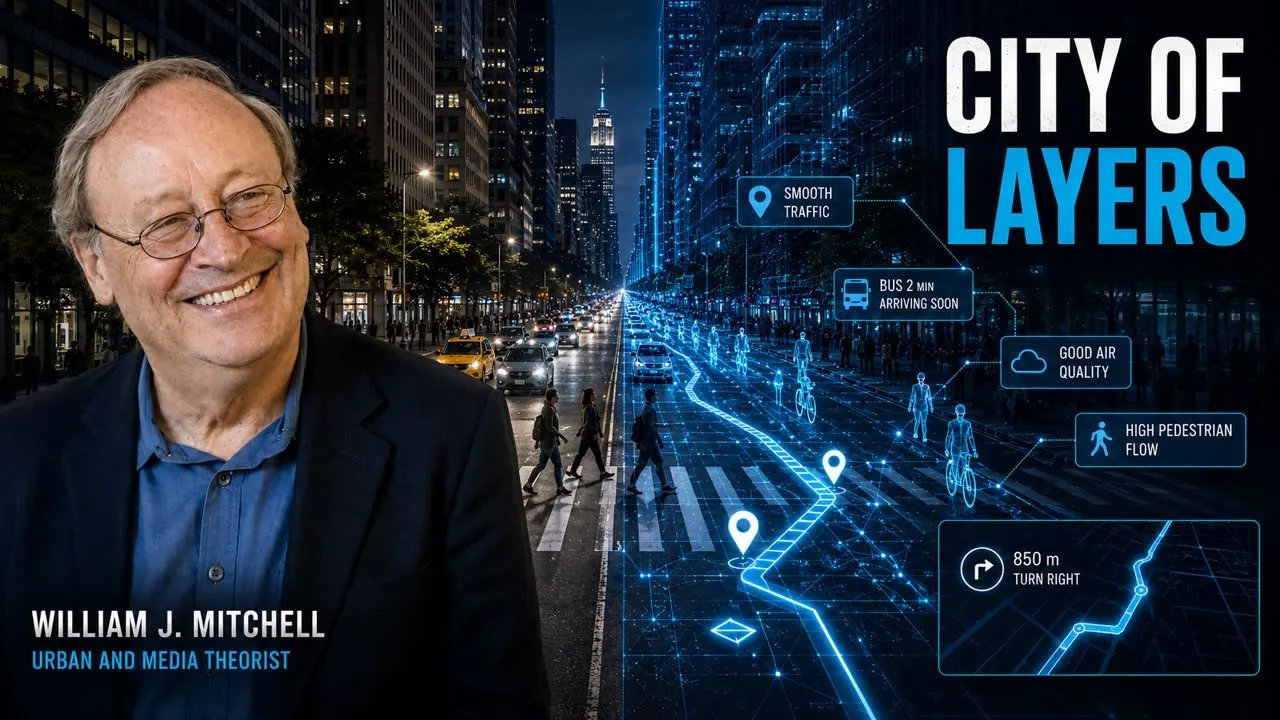
William J. Mitchell anticipated in City of Bits, e-topia and Me++ the hybrid city of matter and information: the…
William J. Mitchell 3 min read