You have to give the contemporary conspiracy machine some credit: it has an extraordinary talent for finding totalitarian threats in the most unsuspecting places. Vaccines, 5G, planes leaving trails in the sky... and now, the ultimate enemy of human freedom: being able to buy bread on foot.Let's start at the beginning, which is almost disappointingly banal. Carlos Moreno, a professor at the Sorbonne, formalized around 2016 the concept of the ville du quart d'heure: the idea that essential urban functions—work, commerce, healthcare, education, leisure—should be accessible within 15 minutes on foot or by bicycle from one's home (Moreno et al., 2021). It is, strictly speaking, a contemporary reformulation of century-old ideas: Clarence Perry's neighborhood units (1929), Jane Jacobs' proximity urbanism (1961), the compact European city of all time. Nothing in the proposal is particularly revolutionary; in fact, it describes rather accurately how every city in the world functioned before the automobile reorganized them in its own image. Paris before Haussmann was a 15-minute city. A medieval English market town is a 15-minute city. The conspiracy, it seems, has been operating for centuries.But then came 2023, and with it, paranoia's finest hour. Oxford announced a traffic filter scheme—a road management measure as British and as gray as one might expect—and the digital conspiracy ecosystem worked its magic. Within weeks, the 15-minute city went from being a soporific slide at urban planning conferences to a "climate concentration camp," a World Economic Forum plan to confine the population in surveilled ghettos, ban travel, and, presumably, force us all to eat insects while riding bicycles. There were demonstrations in Oxford with banners against "urban imprisonment." British MPs spoke in Parliament of an "international socialist concept." All over some bollards and traffic cameras that have existed across Europe since the 1990s.The mechanics of the delusion deserve analysis, because it's a textbook case. First, the fusion of grievances: Moreno's concept was blended with pandemic lockdowns (still fresh in collective memory), with low-emission zones (which do indeed hit the wallets of those driving older cars), and with Agenda 2030 (that UN document nobody has read but everybody fears). Second, the semantic inversion: where the urbanist says "everything close to you," the conspiracist reads "you can't leave." It's a fascinating operation: accessibility reinterpreted as confinement, proximity as prison perimeter. By that logic, having a supermarket downstairs would constitute a form of house arrest.The truly ironic part—and here one should savor the moment—is the sociological profile of the outrage. A good portion of those denouncing the "15-minute tyranny" live in low-density suburbs where car dependency is not a choice but a structural sentence: without a car there is no job, no doctor, no school, no social life. In other words, they vehemently defend their right to a territorial model that forces them to spend thousands of dollars a year on a vehicle, waste hundreds of hours in traffic jams, and depend on ruinously expensive infrastructure. Freedom, understood as the inescapable obligation to drive 40 minutes to buy milk. Rousseau would weep; the automotive lobby, on the other hand, applauds with tears of gratitude, for it never had defenders so enthusiastic and so unpaid.The academic literature has already begun dissecting the phenomenon. Research on climate disinformation documents how the 15-minute city conspiracy theory spread from denialist accounts into mainstream politics in record time, following the usual circuits of the digital far right. Moreno himself, who went from discreet academic to receiving death threats—a career advancement no citation index accounts for—has described it as part of a broader culture war against any urban climate policy. And therein lies the key: the panic isn't really about urbanism. Nobody protests against superblocks out of morphological conviction. The 15-minute city functions as an empty signifier onto which the underlying anxiety is projected: the suspicion that global elites are plotting to restrict the fossil-fuel-based lifestyle. That this restriction comes disguised as a neighborhood bakery apparently makes it all the more sinister.That said, the matter shouldn't be dismissed with pure condescension, because the phenomenon reveals something uncomfortable for the discipline: urban planning has a communication and trust problem. Proximity policies have often been implemented technocratically, without pedagogy or genuine participation, in contexts where green gentrification is a documented threat (Anguelovski et al., 2019). When planning is perceived as something done to people rather than with people, it opens up precisely the space where conspiracy thrives. The delusion of climate ghettos is absurd; the distrust that feeds it, not so much.The net result is a comedy wi
15 minutes City: Urban Planning Concept Became the New World Order's Master Plan
Shorts
 ’s Green Myth One of Europe’s capitals…
 Killer heat
 Sponge Cities The city that stopped fighting water
 Cities Are Hiding SECRET Jungles on Their Walls!
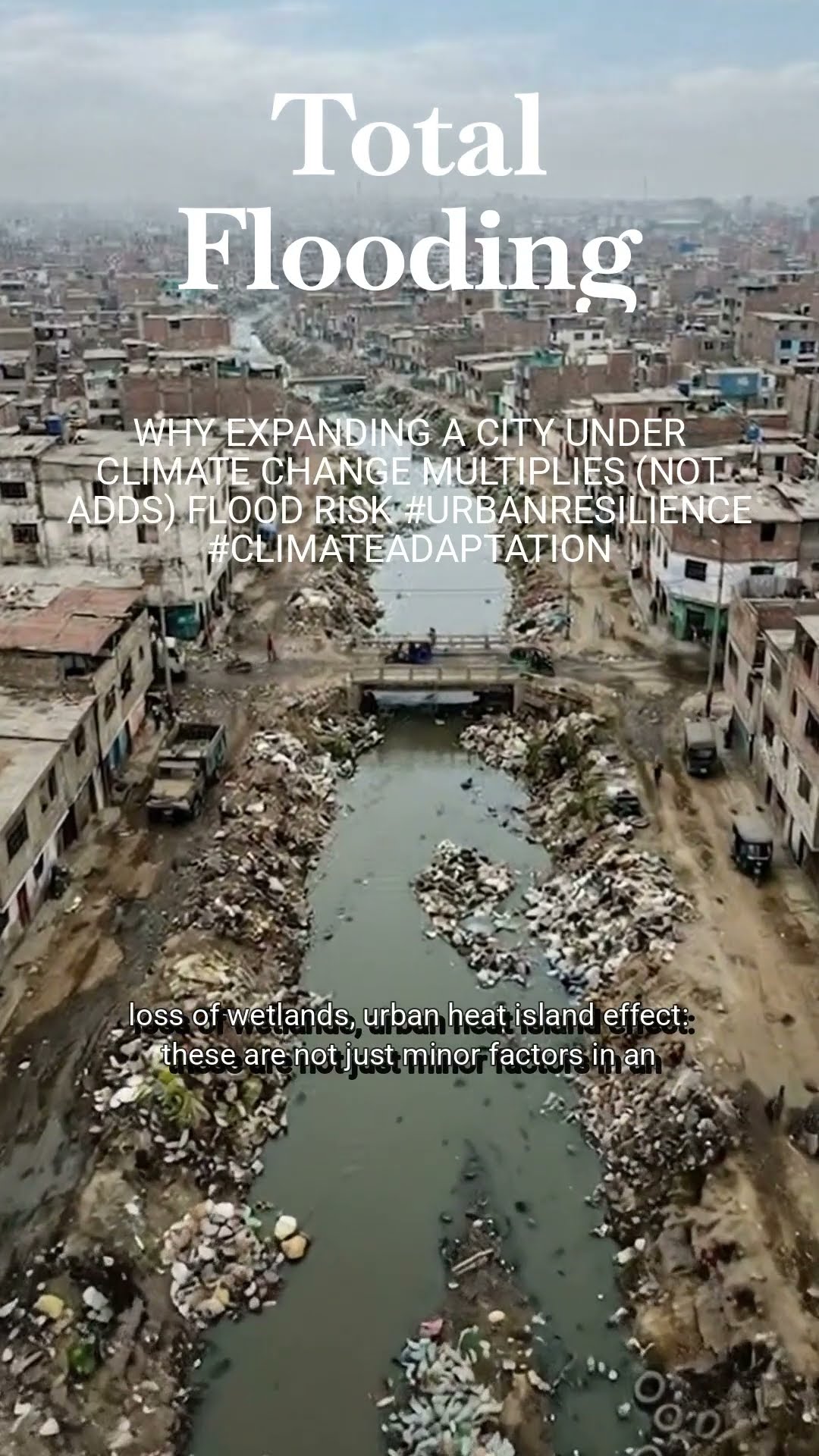 Total flooding. Why expanding a city under climate change multiplies flood risk
 HafenCity. The Futuristic District That Quietly Redefined a City
 Underground Cities. The climate solution isn’t above us… it’s hidden beneath our feet
 Color and Climate. The color that cools cities without air conditioning
 Healing parks. A tree on your street isn't decoration. It's a medical intervention
 Invisible infrastructures. The city’s most powerful highway can’t be seen
 Cities Are Running Out of Land… So They’re Building on Water
 vs Highways. Imagine a highway. Now imagine your city destroys it
More from the channel ↗