Key points
- Graham: networks that were universal services are unbundled into premium services for those who pay and degraded ones for the rest.
- Two areas a few kilometres apart live at different times depending on the network that serves them: mobility differentiates territories.
- Cameras, sensors and algorithms move from connecting to classifying and reproduce inequality with the appearance of efficiency.
Unequal connection is how technology divides and connects cities at once, and Stephen Graham, a geographer at Newcastle University, made it an object of study by proposing that we see transport, telecommunications, energy and data networks as a geography of power. A train crosses the city without stopping in all its neighbourhoods, energy and data circulate underground, a camera above the street distinguishes movements and bodies, and none of those networks is a neutral background: they organise different access, speeds and possibilities for different people. Graham's question is what happens when infrastructure connects some intensely while leaving others at the margin, and his answer is that social inequality acquires cables, stations, routes and algorithms.
Fragmentation and bypass: premium networks that skip neighbourhoods
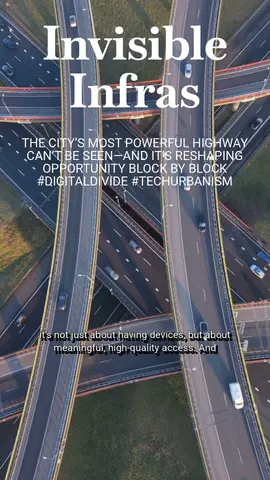
The first mechanism is fragmentation. In Splintering Urbanism (2001), with Simon Marvin, Graham showed that the networks the twentieth century built as universal services, with single tariffs and mandatory coverage, have been unbundled by privatisation and competition into premium services for profitable customers and degraded services for the rest. Fibre optics reach financial districts and technology parks and skip poor neighbourhoods; toll highways and express trains connect airports and business centres without stopping in the peripheries they cross; enclaves with their own generators, tanks and security disconnect from the city around them. Graham calls that geography of leaps the bypass.
Time as inequality: the same city at different speeds
The second mechanism is time. Two areas of the same city can be a few kilometres apart and very different times apart depending on the network that serves them: a station, a direct route or a reliable connection widen a place's opportunities and their absence reinforces isolation. Mobility thus works as territorial differentiation, and groups with fewer resources, dependent on slow public networks, live in a larger and slower city than those with fast connections. The same applies to energy and data: in Global South cities, power cuts and patchy digital coverage determine which activities are possible in each neighbourhood.
From connecting to classifying: software-sorted geographies
The third mechanism is classification. In his work on software-sorted geographies, Graham analysed how cameras, sensors, databases and algorithms not only carry information but sort people: systems that prioritise the traffic of those who pay, access controls that decide who enters a space, risk profiles that assign more surveillance to some neighbourhoods than others. Technology moves from connecting to classifying, and that automatic, invisible classification reproduces existing inequalities with the appearance of technical efficiency. His later analysis of urban militarisation extends that line.
Counterargument and policies: universal networks, open data, limits
The counterargument is that networks need technical priorities, that no system offers the same service everywhere and that surveillance can be justified by security or management, so unequal connection does not prove deliberate exclusion. Graham partly accepts it: his point is not that every difference is a malicious decision but that differences accumulate, are designed and can be corrected, and that presenting infrastructure as neutral is what prevents it from being debated politically. Universal networks, social tariffs, open data and limits on surveillance are the policies that return connection to the public sphere.
Graham's lesson is that infrastructure is solidified politics: every network decides whom it serves, at what speed and at what price, and a city that leaves those decisions to the market and to algorithms produces a geography of the connected and the disconnected that later seems natural. Seeing networks as power allows one to ask why the train does not stop in certain neighbourhoods, why the fibre skips them and why the camera watches them more, and those questions are the starting point of a city that connects without dividing.
Frequently asked questions
What is splintering urbanism according to Stephen Graham?
It is the city in which transport, telecommunications, energy and data networks, built in the twentieth century as universal services, have been unbundled by privatisation into premium services for profitable customers and degraded services for the rest, producing connected enclaves and neighbourhoods skipped by fibre, toll highways and express trains.
How does technology divide the city?
By connecting some and leaving others at the margin through networks that set different access, speeds and prices, and by classifying people with cameras, sensors and algorithms that prioritise those who pay and watch some neighbourhoods more; Graham proposes universal networks, social tariffs, open data and limits on surveillance.