
Stephen Graham
1965
British geographer who studies infrastructure and security: the pipes, networks and walls that decide who gets what.
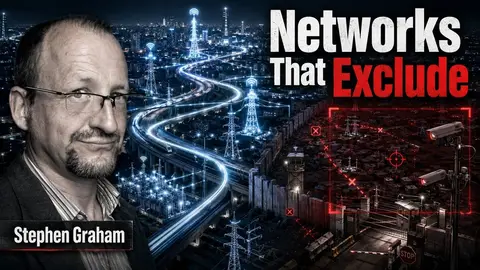
With Simon Marvin he described «splintering urbanism»: the breaking up of public networks — water, electricity, transport, telecommunications — into services of different quality depending on who pays. Infrastructure stops being a city's common minimum and becomes the instrument that divides it.
His other line of work is the militarisation of urban space: cameras, drones, crowd control and techniques imported from war zones that end up deployed in ordinary neighbourhoods. And in Vertical he turned to the axis almost nobody analyses, from the bunker to the penthouse, where inequality is also measured in height.
A British geographer, professor of cities and society at Newcastle University, Graham began by studying urban telecommunications in Telecommunications and the City (1996, with Simon Marvin) and with the same co-author wrote Splintering Urbanism (2001), the book that showed how water, energy, transport and data networks, unbundled and privatised, connect privileged enclaves and bypass the rest of the city. It is one of the most cited works in this century's urban studies.
He then turned to security: Cities, War and Terrorism (2004), Cities Under Siege (2010) and Disrupted Cities (2010) describe the new military urbanism, in which the techniques of war and surveillance travel from Baghdad and Gaza to London and New York and infrastructures become targets. Vertical (2016) added the dimension of height, from satellites to bunkers. Critics reproach him for a sombre tone; his contribution is to have made infrastructure visible as a field of power.
Videos on Stephen Graham (5)
- Urban ecology
Unequal Connection: Stephen Graham and Technology in the City
Stephen Graham shows that transport, energy and data networks are a geography of power: fragmentation, bypass,…
Stephen Graham 3 min read - Surveillance / data
Stephen Graham: Militarisation and Surveillance in the City
Stephen Graham describes in Cities Under Siege the new military urbanism: how techniques of war, surveillance and…
Stephen Graham 2 min read - Urban form
Vertical by Stephen Graham: The City from Satellites to Bunkers
Stephen Graham shows in Vertical that the city is a volume: skyscrapers and drones above, tunnels and bunkers…
Stephen Graham 3 min read - Infrastructure
Graham and Marvin: Splintering Urbanism and Inequality
Splintering Urbanism explains how transport, water, energy and telecommunications networks stopped integrating the…
Stephen Graham 2 min read - Infrastructure
Critical Infrastructure: Urban Vulnerability per Stephen Graham
Critical infrastructure fails more often and in cascade. What Stephen Graham's Splintering Urbanism and Disrupted…
Stephen Graham 3 min read




Where Stephen Graham is cited (6)
- Public space
Urban Territoriality: Inclusion and Exclusion (Low and Delaney)
Urban territoriality explains how groups and institutions mark and control city space. What Setha Low and David…
3 min read - Infrastructure
Urban Infrastructure, Power and Inclusion: Star and Larkin Explained
Urban infrastructure decides who belongs to the city. What Susan Leigh Star and Brian Larkin propose, Graham and…
3 min read - Surveillance / data
Urban Security and Technology: Surveillance (Lyon and Graham)
Cameras, drones and facial recognition are transforming urban security. What David Lyon and Stephen Graham explain,…
3 min read - Urban geopolitics
Postcolonial Urban Fragmentation: Inequality and Resistance
Why postcolonial cities remain divided: Fanon's city, Graham and Marvin's splintering infrastructure, Caldeira and…
3 min read - Urban economy
Deborah Cowen: Global Logistics, Power and Urban Transformation
Deborah Cowen shows in The Deadly Life of Logistics that global logistics was born in war and now governs ports,…
Deborah Cowen 3 min read - Surveillance / data
Urban Militarisation: Surveillance and Control (Graham and Davis)
Urban militarisation brings the tactics and technologies of war into the surveillance of cities. What Stephen…
3 min read