Edward Soja
1940–2015
American geographer who claimed for space the same weight that time has in the social sciences.
Soja argued that twentieth-century social thought privileged history and treated space as an inert backdrop. His «spatial turn» holds the opposite: where something happens is part of why it happens, and a city's geography produces inequality as much as its economy does.
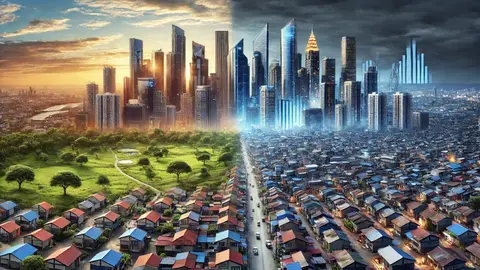
His most applicable formulation is spatial justice. Distributing income better is not enough: access has to be distributed too — to transport, jobs, clean air, the park — because living ninety minutes from everything is a form of poverty no payslip reflects.
An American geographer, born in the Bronx in 1940 and professor of urban planning at the University of California, Los Angeles, until his death in 2015, Soja was the great populariser of the spatial turn in the social sciences. Postmodern Geographies (1989) reclaimed space as a dimension as decisive as time for understanding society, drawing on Lefebvre and Foucault, and Thirdspace (1996) proposed a third space, neither only physical nor only imagined, where the city is lived and contested.
With Postmetropolis (2000) he named the city that came after the Chicago model, dispersed, fragmented and globalised, with Los Angeles as laboratory, and he formed part of the core of the Los Angeles School alongside Michael Dear and Allen Scott. Seeking Spatial Justice (2010) turned his theory into a political programme from the case of the Los Angeles Bus Riders Union, which won in 1996 a court settlement to invest in the buses the poor use. Spatial justice is a common term today thanks to him.
Videos on Edward Soja (2)
- Public space
Thirdspaces: Soja and Bhabha's Third Space in the City
Thirdspaces are the hybrid places where the dichotomies of public and private, centre and periphery break down.…
Edward Soja 3 min read - Public space
Edward Soja and Spatial Justice: The City After Chicago
Edward Soja defined spatial justice: geography produces injustice and changing space is doing justice.…
Edward Soja 2 min read
Where Edward Soja is cited (8)
- Urban form
Edge cities: skylines built at a highway exit
Joel Garreau and Robert Fishman explain edge cities: offices and malls that grew at motorway junctions without…
7 min read - Urban form
Michael Dear: Postmodernism and Critical Urban Planning
Michael Dear led the Los Angeles School and brought postmodernism into urban planning. What the postmodern city is…
Michael Dear 3 min read - Public space
Lefebvre: urban space as a field of struggle
In The Production of Space, Lefebvre separates perceived, conceived and lived space, and shows where capital and…
Henri Lefebvre 2 min read - Public space
Nicholas Blomley: Property, Space and Spatial Justice in the City
Nicholas Blomley shows that property is a spatial practice deciding who may be where. Unsettling the City, Rights…
Nicholas Blomley 3 min read - Urban economy
Land Policy: Power, Value Capture and Spatial Justice
Land policy decides who gains from urban growth. What it is, how Edward Soja links it to spatial justice and which…
2 min read - Urban geopolitics
The Urban Condition: The Fragmented Metropolis of Globalisation
The Urban Condition (1999) by the Ghent Urban Studies Team describes the dispersed metropolis of globalisation and…
3 min read - Public space
Spatial justice: what it is, after Soja and Fainstein
What spatial justice is and how Edward Soja (Seeking Spatial Justice) and Susan Fainstein (The Just City)…
2 min read - Public space
Urban Space and Power: Foucault, Massey and Soja Explained
Urban space is an instrument of power and a field of resistance. What Foucault's panopticon, Massey's power…
2 min read