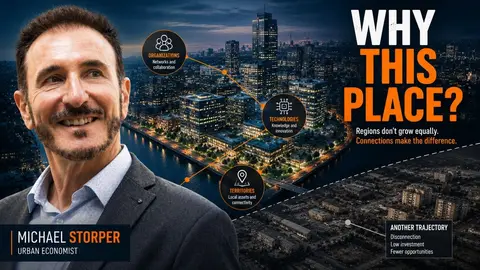
Michael Storper
1954
Economic geographer who explains why some cities prosper and others do not: institutions, networks and knowledge, not just markets or talent.
Born in 1954 and trained at Berkeley, Storper is professor of economic geography at the University of California, Los Angeles, at the London School of Economics and at Sciences Po in Paris. In the 1980s and 1990s, with Allen Scott and Richard Walker, he formed the California school of economic geography, which explained the vertical disintegration of production and the rise of industrial districts, and The Regional World (1997) fixed his idea that a region's economy rests on relational assets that cannot be bought.
Keys to the City (2013) gathers his answer to the question of why some cities grow: the holy trinity of organisations, technologies and territories, and above all the institutions and networks that allow a local economy to learn and change. With that view he criticised both technological determinism and Richard Florida's creative class recipe, which he reproached for reversing causality: people follow jobs, not the other way round.
The Rise and Fall of Urban Economies (2015), with Thomas Kemeny, Naji Makarem and Taner Osman, compared Los Angeles and San Francisco since 1970 to explain why two such similar regions diverged: not because of geography or costs but because of the beliefs and networks of their business elites. He is one of the most cited economic geographers and his work guides the OECD's regional policies.
Videos on Michael Storper (2)
- Urban economy
Why Some Cities Innovate and Others Do Not: Michael Storper
Michael Storper explains why some cities innovate and others do not: organisations, technologies and territories,…
Michael Storper 3 min read - Urban economy
Michael Storper: The Regional World and regional development
What Michael Storper argues in The Regional World: why regions still matter in a global economy, regional worlds of…
Michael Storper 2 min read

Where Michael Storper is cited (5)
- Urban geopolitics
Neil Brenner: Global Urbanization Goes Beyond City Borders
Neil Brenner argues that urbanization does not fit administrative boundaries: scale, state restructuring, extended…
Neil Brenner 3 min read - Urban AI
Proximity Transforms: Edward Glaeser on Productive Cities
Edward Glaeser explains why concentrating people and firms makes cities more productive: agglomeration, human…
Edward Glaeser 3 min read - Urban economy
Richard Florida and the Creative Class: What the Evidence Says
How Richard Florida measures the creative class with the three Ts and his indices, how it became fast policy and…
Richard Florida 3 min read - Urban form
Reurbanization and Urban Renewal: Opportunities, Risks and Cases
Reurbanization reuses central land but can expel residents. What Sharon Zukin, Neil Smith and Michael Storper…
3 min read - Infrastructure
Urban Infrastructure and Competitiveness: Glaeser, Florida, Storper
Why urban infrastructure decides economic competitiveness: Glaeser on connecting people, Florida on talent, Storper…
2 min read