Rob Kitchin
1970
Irish geographer who takes the smart city apart: he asks who defines the problem before celebrating the solution.
With Martin Dodge he coined «code/space» to name places that stop working if the software fails: an airport without a check-in system is not a slow airport, it is a useless building. The city now depends on code that almost nobody audits and that belongs to private companies.
On the smart city his critique is precise: indicators are not neutral. Measuring traffic and not pollution, or efficiency and not equity, does not describe the city — it decides what counts as a problem. And whoever chooses the indicators is usually whoever sells the sensors.
An Irish geographer, professor at Maynooth University, Kitchin moved from the geography of disability and cartography to become the reference analyst of the digital city. Code/Space (2011, with Martin Dodge) showed that many urban spaces, from the airport to the supermarket, no longer work without software, and The Data Revolution (2014, second edition 2022) fixed the vocabulary for thinking about big data, open data and their infrastructures.
With the Programmable City project, funded by the European Research Council, and the Dublin Dashboard, he studied from the inside how a city is governed through dashboards, and from there came his critiques of the corporate smart city: data are never raw, rankings are opinions with decimals and smart citizenship is usually a scaffold without power. The Right to the Smart City (2019), Slow Computing (2020) and Data Lives (2021) propose alternatives. He is a member of the Royal Irish Academy.
On Rob Kitchin in this archive (6)
- Urban AI
William J. Mitchell: The Future City, Information and Connection
William J. Mitchell anticipated in City of Bits, e-topia and Me++ the hybrid city of matter and information: the…
William J. Mitchell 3 min read - Urban ecology
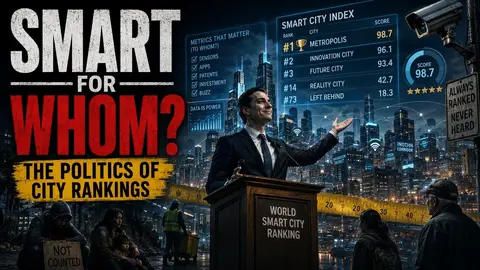
Smart for Whom? The Other Side of Smart City Rankings
Smart city rankings do not describe the city but define it: what they measure, what they omit, how weighting…
3 min read - Urban geopolitics
Urban Geography in the 21st Century: Challenges and New Frontiers
How urban geography has changed: theory beyond the Global North, cities and climate change, technologies of…
2 min read - Urban AI
Hybrid Urban Space: Physical and Digital (Castells and Shields)
Hybrid urban space overlays the street and the platform. What Castells's space of flows and Shields's mythology of…
3 min read - Urban AI
Technopolitics and Urban Governance per Kitchin and Jasanoff
Urban technopolitics decides who owns a city's data and which algorithms govern. What Rob Kitchin and Sheila…
3 min read - Urban AI
The Right to the Smart City: Who Benefits from Digital Cities?
The Right to the Smart City, edited by Cardullo, Di Feliciantonio and Kitchin, carries Lefebvre's right to the city…
3 min read