A street covered in mud. Residents with buckets and brooms have been bailing water since dawn. An official delegation arrives, steps carefully, faces the cameras and delivers the expected line: we must admire the resilience of these people. Applause, headlines, next story. Nobody asks why the water reached the bedrooms. The scene could belong to almost any recent city, and that is where this video begins. When power calls you resilient, is it praising you or apologizing to you? And here is the provocation we will hold until the end: what if asking for resilient cities means accepting, in advance, that we are going to flood them? To understand this, follow the word's trail. Resilience comes from materials physics: the capacity of a body to recover its shape after a blow. Ecology adopted it later, through the research of Holling, to describe ecosystems that absorb disturbance without collapsing. From there it jumped to psychology, and from psychology to urban planning and global agendas. At every jump, a decisive semantic operation took place. Disaster became an external fact, almost natural, something that simply happens. The question changed places. It is no longer why did this happen, but how much can we take and how fast can we recover. The causes vanish from the picture. Only adaptation remains. That shift has deep political consequences. As the researchers Brad Evans and Julian Reid argue, the resilient subject is one who accepts living in permanent danger. It no longer expects security: it trains itself to absorb the blow. Protection stops being a promise of the system and becomes a duty of the individual. Buy insurance, raise your power sockets, pack an emergency bag, learn to evacuate. Meanwhile, the system keeps building on floodplains, cutting maintenance and heating the atmosphere. The researcher Mark Neocleous sums it up in an unsettling slogan: do not be scared, be prepared. It can be argued that this slogan contains the whole problem. It turns a question of responsibility into a question of attitude. First case. When hurricane Katrina devastated New Orleans, public discourse celebrated the extraordinary resilience of its communities. The word worked as a narrative balm. While endurance was being praised, reconstruction advanced in deeply unequal ways. The poorest neighborhoods, hit hardest by the failure of the levees, were the slowest to return, when they returned at all. Many residents never came back. The evidence shows that the recovered city was whiter and more expensive than the flooded one. The celebrated resilience of some coexisted with the silent displacement of others. Praising endurance served, in practice, to avoid discussing who decided what got rebuilt and for whom. Second case. Some years ago, a large philanthropic foundation launched a global program of one hundred resilient cities. It funded strategies, consultancies and even a new position inside city governments: the municipal resilience officer. Dozens of cities competed to join the network and display the label. Resilience became a brand, a reporting language, a requirement for attracting funds. This can be read as a useful push for prevention. But it also revealed the fragility of the concept: when the foundation withdrew its money, the program was dismantled in a short time. The irony is hard to dodge. Institutional resilience turned out to be not especially resilient. The word survived, and today it heads urban agendas around the world. Third case, closer to home. When torrential rains devastated the south of Valencia recently, the word arrived before much of the help did. Officials praised the resilience of residents who organized themselves with buckets, brooms and hot food. The praise was deserved: that solidarity was real and admirable. The problem is what the praise covered up. Far less was said about why thousands of homes and industrial estates sat in known risk zones, or why the warnings failed. Here is the edge of the argument. Celebrating the capacity to endure is convenient for whoever produced the risk. The political question is not how much a neighborhood can take. It is who manufactured the danger and who pays for adaptation. Let us be loyal to the counterargument, because it is strong. The climate has already changed: adapting is not surrendering, it protects lives, and refusing adaptation would be irresponsible. Ecological resilience, moreover, is a serious scientific field, not an excuse. Many communities claim the word with legitimate pride. And some authors propose repoliticizing it: speaking of transformative resilience, which does not seek a return to the previous state but a change in the model that produced the damage. All of this is true. The answer is not to abandon adaptation, but to name it in full. Some critical geographers propose another criterion: what matters is less whether a community endures, and more whether it has the reso
Resilience is just a mask for resignation
Shorts
 ’s Green Myth One of Europe’s capitals…
 Killer heat
 Sponge Cities The city that stopped fighting water
 Cities Are Hiding SECRET Jungles on Their Walls!
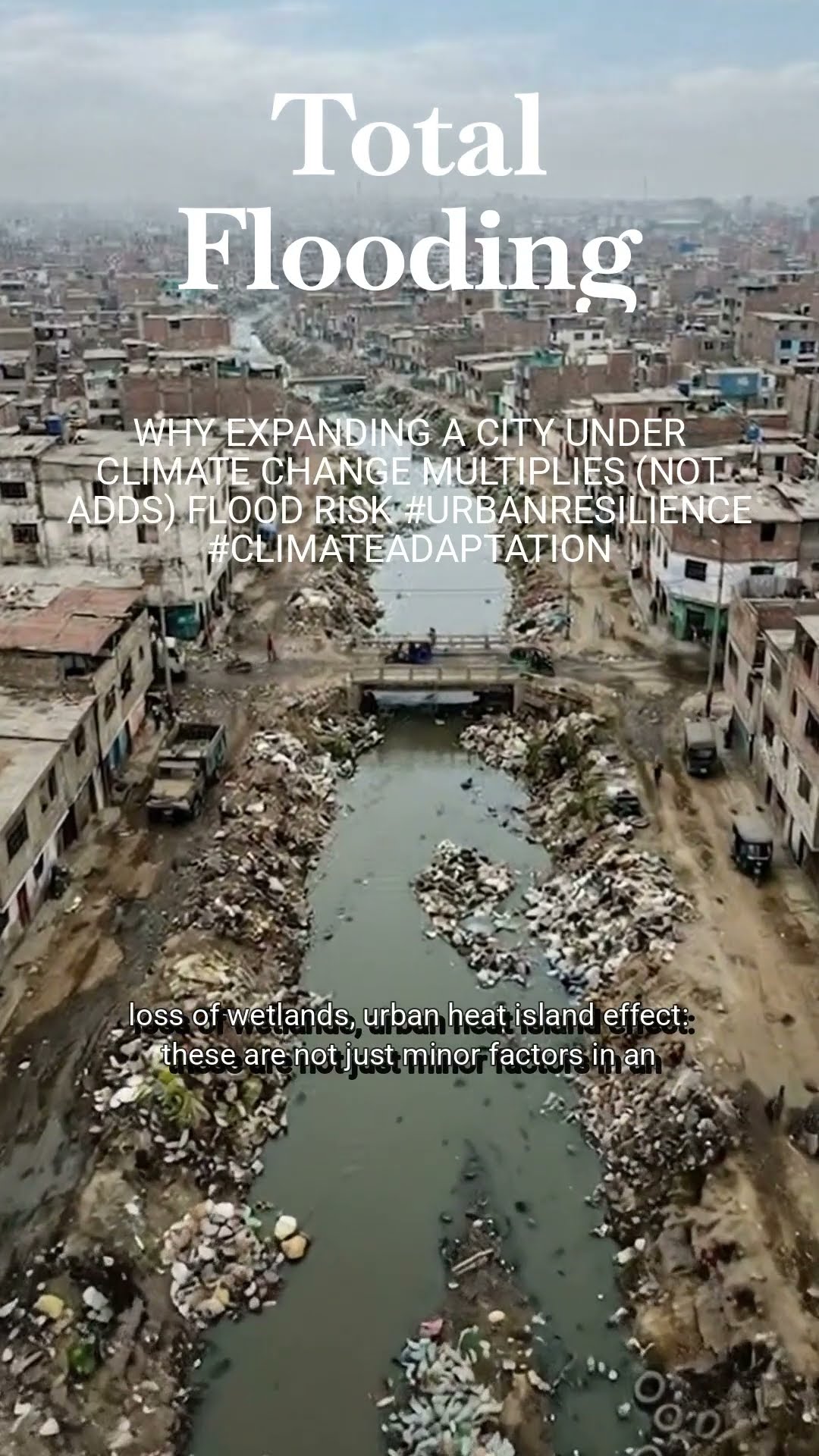 Total flooding. Why expanding a city under climate change multiplies flood risk
 HafenCity. The Futuristic District That Quietly Redefined a City
 Underground Cities. The climate solution isn’t above us… it’s hidden beneath our feet
 Color and Climate. The color that cools cities without air conditioning
 Healing parks. A tree on your street isn't decoration. It's a medical intervention
 Invisible infrastructures. The city’s most powerful highway can’t be seen
 Cities Are Running Out of Land… So They’re Building on Water
 vs Highways. Imagine a highway. Now imagine your city destroys it
More from the channel ↗