A July afternoon at a bus stop with no shelter. Half a dozen people standing, squeezed into the narrow strip of shade cast by a signpost. There is not enough room. They take turns. Two hundred metres away, a street lined with old plane trees and café tables offers continuous shade, a breeze and several degrees less. Neither scene is an accident: both were decided on a drawing. Shade is no longer a detail of the landscape or an aesthetic luxury. In a southern european summer, shade is survival infrastructure. And the question this video holds is simple and rather uncomfortable. If shade decides who endures the heat and who does not, why do we still treat it as decoration instead of a measurable urban right? Start with the mechanism, because shade does not appear on its own. It is produced by mature trees, street orientation, building height, awnings, arcades and shelters. All of that costs money, maintenance and technical decisions taken decades in advance. A large tree needs fertile soil, water, pruning and patience; a small tree in a suffocated pit gives no useful shade. Wide, open streets, designed for the car, take direct sun almost all day. Narrow, dense streets protect themselves. In other words: shade is inherited from earlier planning. The neighbourhoods that were designed in a hurry, on a tight budget and with traffic as the priority, are the neighbourhoods that cook today. The effects show up in health statistics. Heatwaves have become the deadliest natural phenomenon in many countries, ahead of floods or storms. And the victims are not distributed at random. As the journalist Sam Bloch documents in his investigation into shade, the poorest areas of several cities record ambient temperatures far above those of wealthy districts in the same city, with gaps that can reach several degrees. Bloch adds one fact that organises the whole debate: the neighbourhoods once excluded by discriminatory housing policies still show the highest land surface temperatures today. Thermal inequality is not an effect of the climate. It is an effect of planning, delayed by several generations. Bloch's strong claim is that shade works as an index of inequality, a public health requirement and a mandate for urban design. And here it is worth pausing on the invisible part. When a council decides where to plant and where not to, it is distributing degrees of temperature among its residents. When it approves a hard plaza with no trees, it is deciding who will be able to use it in summer. When it removes awnings on aesthetic grounds, it is cutting a piece of health infrastructure. None of this is debated in those terms. It is discussed as gardening, as ornament, as street furniture. Shade is one of the few public policies decided without ever being called a public policy. That invisibility explains why it is almost never measured, audited or demanded. There is an interesting counterexample, and it comes from Australia, a country forced by its skin cancer rates to take shade seriously. There, official guidelines exist for planning shade, along with one very concrete tool: the shade audit. It means going out into the space, tracking the path of the sun, watching how the place is used, and assessing whether shade exists where people actually are, at the hour they are actually there. One study reviewed more than two thousand five hundred playgrounds in a single state. Almost one in five had no shade at all over the play equipment. Among those that did, the norm was covering barely a quarter of the area. From there, the authorities set a quantified coverage target, combining trees and built structures. That is the exportable lesson. An audit turns a vague feeling into a verifiable, comparable indicator. How much pavement is in shade at four in the afternoon. How many bus stops have a roof. What share of the walk to school or to the health centre is protected. One can argue this is the real conceptual shift: moving from trees as scenery to the shaded route as a guaranteed service. Cities in southern Europe are already working on cool itineraries, with awnings, trees and fountains. Seville has tested bringing back traditional street awnings in its centre. The technology is not new. In fact, it is the oldest one of all: getting out of the sun. The counterargument deserves to be taken seriously. Planting trees is neither free nor immediate. Dense canopy consumes water in territories where water is the critical resource, and many urban species are dying from drought stress and heat. Shade also has a known side effect: leafy, cool streets become more desirable and more expensive, a phenomenon the literature calls green gentrification. Improving a neighbourhood can end up displacing the people who lived there. The answer is not to give up shade, but to combine it with rent protection, with built shade where water cannot stretch further, and with allocation c
The shadow, a divisive privilege in extreme heat
Shorts
 ’s Green Myth One of Europe’s capitals…
 Killer heat
 Sponge Cities The city that stopped fighting water
 Cities Are Hiding SECRET Jungles on Their Walls!
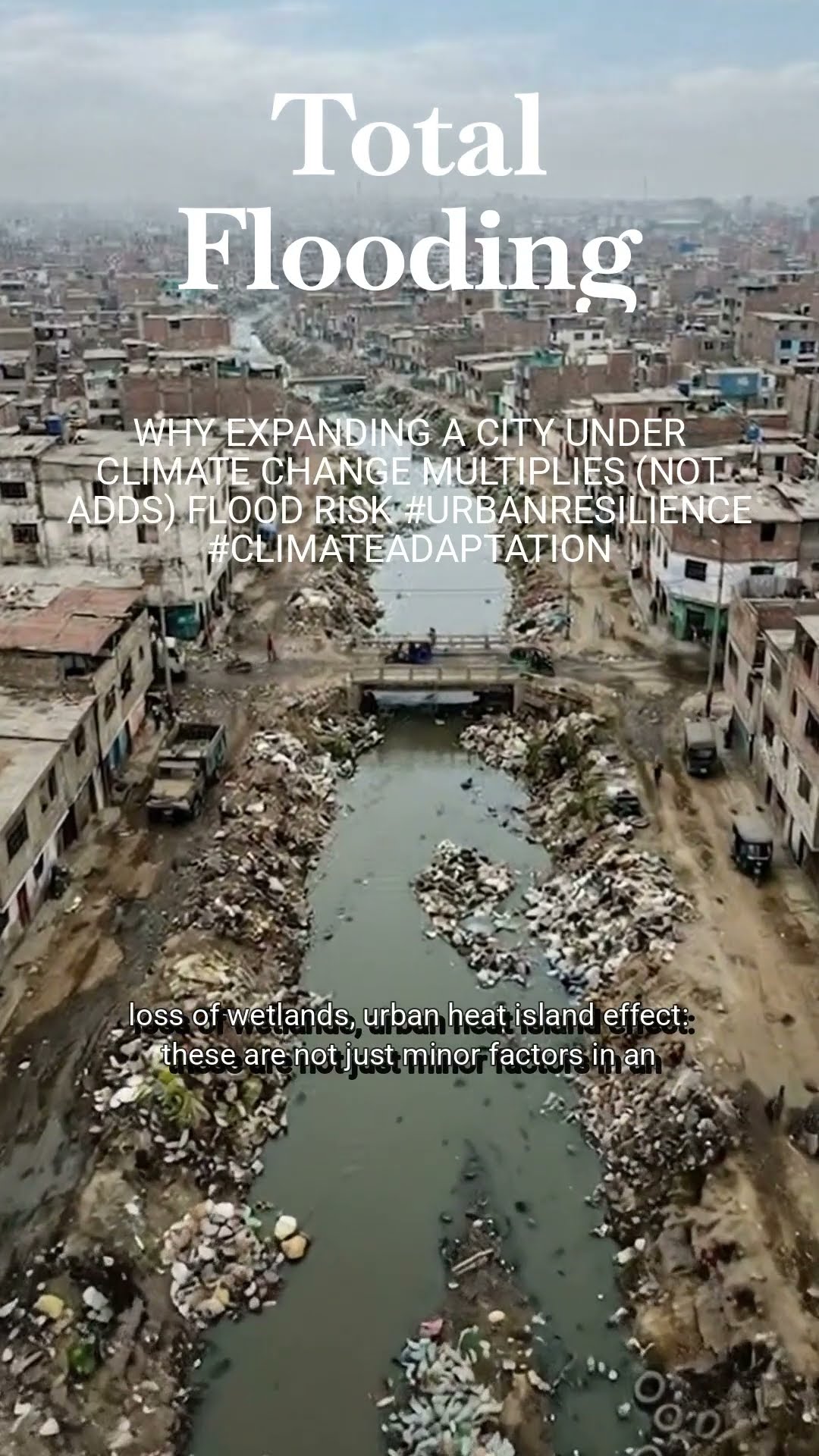 Total flooding. Why expanding a city under climate change multiplies flood risk
 HafenCity. The Futuristic District That Quietly Redefined a City
 Underground Cities. The climate solution isn’t above us… it’s hidden beneath our feet
 Color and Climate. The color that cools cities without air conditioning
 Healing parks. A tree on your street isn't decoration. It's a medical intervention
 Invisible infrastructures. The city’s most powerful highway can’t be seen
 Cities Are Running Out of Land… So They’re Building on Water
 vs Highways. Imagine a highway. Now imagine your city destroys it
More from the channel ↗