A city of nearly four million people receives an order: fifty litres per person per day. One household figure makes that number real. Filling a bath uses around two hundred litres, and a toilet cistern spends fifteen with every flush. The city prepared for what it called day zero, the date when taps would close and people would collect twenty five litres a day at guarded distribution points. That day never came, but only just. The image travelled the world. The question holding this video together is not when it will rain again. It is another. Who runs out of water first, and why is that almost never decided by the climate? Follow the journey of water to understand it. It begins in a catchment, gathers in a reservoir or an aquifer, travels along a main, passes through a treatment plant and enters a distribution network reaching your tap. There are losses at every stage. Evaporation takes part of the reservoir, especially in heat and wind. The network takes another enormous share: Cape Town itself estimates it loses close to a quarter of its water to leaks and unaccounted consumption. Hold on to that. A city's first water reserve does not sit in the mountains, it sits buried under its own streets, and it is usually the cheapest one to recover. The second point is a planning one, and it is the one almost never debated. Water demand does not fall from the sky, it is designed. Dispersed growth of detached houses with gardens and pools multiplies consumption per inhabitant compared with compact apartment fabric. A golf course or a lawn park in a dry climate drinks like a whole neighbourhood. And tourism concentrates its demand peak exactly in the months of lowest reserves. What matters is the order of decisions: the plan approves growth first and asks where the water will come from afterwards. The resource is treated as a guaranteed supply rather than a physical limit. The third point is distributive, and it is the most uncomfortable. A study of the Cape Town crisis estimated sharply different consumption by social group. Elite households could exceed two thousand litres a day per home. Low income households sat at roughly one hundred and seventy eight litres. Informal settlements barely reached forty one. The authors noted that a minority of around fourteen percent of the population used about half of the drinking water. When a general restriction arrives, the household using two thousand litres trims luxuries. The household using forty one has nothing to trim, because it was already living its own day zero. Spain has already run the dress rehearsal, and it is well documented. During the last severe drought, reserves in Catalonia's internal basins fell to a historic low near fourteen percent, and one emblematic reservoir dropped to around five percent of capacity. An emergency was declared in the system supplying metropolitan Barcelona. The measures were concrete: a cap of two hundred and ten litres per inhabitant per day in affected municipalities, a ban on filling private pools, garden irrigation permitted only with reclaimed water. Some towns had to be supplied by tanker truck. All of that happened in a European country with modern infrastructure. And here comes the most dangerous effect, which is psychological and political. When the rain returns and reservoirs recover, the alarm switches off. Consumption goes back to earlier levels, and sometimes beyond them, because abundance relaxes vigilance and encourages new approvals. The record shows each drought cycle is met with a higher baseline demand than the last. This can be read as a problem of collective memory: we manage water by looking at today's level rather than the decade's trend. And the infrastructure that corrects that trajectory, such as network renewal or water reuse, takes years and cannot be inaugurated with an attractive photograph. Now the counterargument, and it is solid. In volume terms, domestic urban consumption is a minor share of the total. Irrigated agriculture takes the overwhelming majority of water in countries like Spain, and no short shower offsets one badly irrigated hectare. On that reading, blaming gardens and cisterns is a convenient distraction that avoids the real conflict, which lies in the farming model and in irrigation licences. Supporters add that supply side solutions exist: desalination, reclaimed water, transfers between basins. Scarcity, they argue, is a technical and financial problem before it is an urban one. It can still be argued that this confuses volume with criticality. Cities do consume a small proportion, but they consume it unpostponably and in concentrated form, competing for the same resource in the same critical month. Urban planning also decides more than how much water is used: it decides where demand will sit, on which network, and at what pumping cost. Desalination carries an energy and environmental price that somebody pays, u
Water, a resource not everyone can enjoy equally
Shorts
 ’s Green Myth One of Europe’s capitals…
 Killer heat
 Sponge Cities The city that stopped fighting water
 Cities Are Hiding SECRET Jungles on Their Walls!
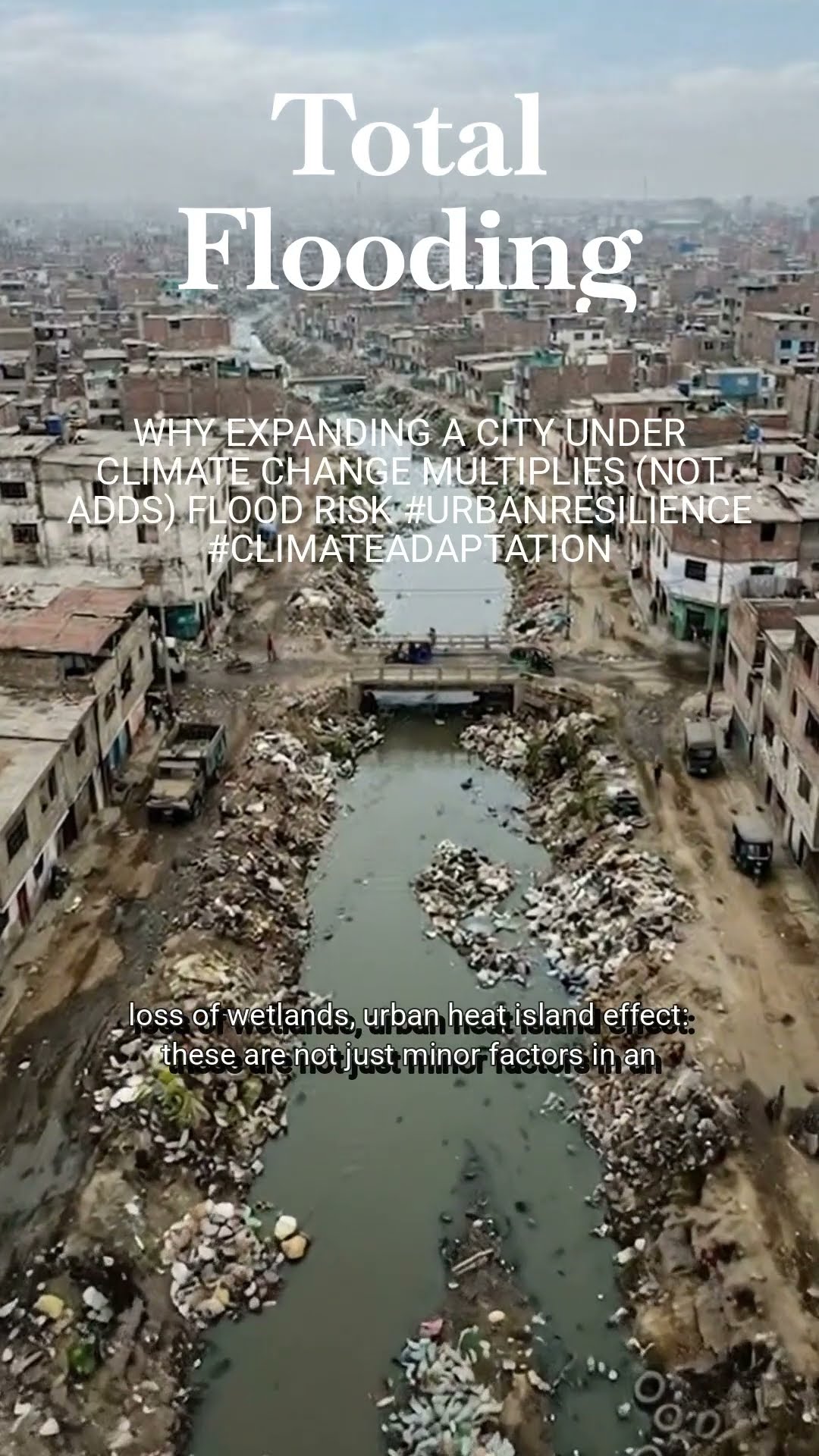 Total flooding. Why expanding a city under climate change multiplies flood risk
 HafenCity. The Futuristic District That Quietly Redefined a City
 Underground Cities. The climate solution isn’t above us… it’s hidden beneath our feet
 Color and Climate. The color that cools cities without air conditioning
 Healing parks. A tree on your street isn't decoration. It's a medical intervention
 Invisible infrastructures. The city’s most powerful highway can’t be seen
 Cities Are Running Out of Land… So They’re Building on Water
 vs Highways. Imagine a highway. Now imagine your city destroys it
More from the channel ↗