Key points
- Land value gains are born of a public decision: rezoning multiplies the value of land without anyone having invested.
- The anchor facility and the district brand signal the market and separate the new land from the adjoining working-class neighbourhood.
- Puerto Madero is the most expensive district in Latin America and left no social housing or value capture for the rest of the city.
Luxury built with public funds raises the question of who benefits. Walk along an avenue of pale granite with aligned trees, designer lampposts and a single-origin coffee shop, glass buildings and a district with a brand name; go back a decade and a half and on that same spot there were sheds, dead railway tracks, a grain silo and a rusty fence, nobody wanted to live there and the land was worth little. The transformation is always told as if it had happened by itself, driven by people's taste, and it did not: a luxury district is manufactured in four steps, and in almost all of them the public sector supplies what creates the price.
Rezoning and infrastructure: land value gains are born of a public decision
The first step is regulatory and it is the cheapest. Someone signs a change of plan: industrial or port land is rezoned, residential and commercial use is allowed, buildable floor area is raised, and that administrative act, which costs not a single work, multiplies the value of the land at once; a square metre that only admitted a warehouse now admits high-rise housing and the owner becomes much richer that same afternoon without having invested anything.
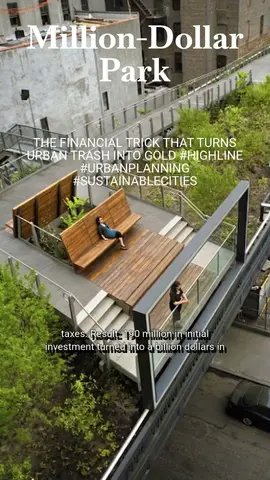
This point is worth keeping because it explains the rest: urban land value gains are born of a public decision, not a private initiative. The second step is public investment, and it is the most expensive: a metro line is extended, a railway is buried, a waterfront is cleaned up, streets are laid out, networks are brought in and a park is built, and all of it is paid by the community to make usable a piece of land that was not.
Anchor facility and brand: signalling the market and separating from the neighbourhood
In parallel appears the anchor facility, a museum, a campus, a cultural centre or an administrative headquarters, whose real planning function is not cultural but signalling: it tells the market that the place has changed category and that private investment will arrive accompanied. The third step is symbolic and is usually underestimated: the area receives a new name, almost always with the word district, a letter or a reference to water or innovation, a visual identity is commissioned, sales material is produced and the trade press is invited. The brand does something very concrete: it mentally separates the new land from the adjoining working-class neighbourhood, even if they are a hundred metres apart, and that separation later justifies an enormous price difference between two neighbouring streets.
Phased sales: where the money is shared out
The fourth step is phased sales, and that is where the money is shared out. Plots are released in batches, so that each sale rests on the price reached by the previous one; the first buyers take on risk and capture the largest appreciation because they buy before the infrastructure is finished, and when the district already works the remaining land is worth several times more. If the contract does not set what share of that rise returns to the city, nothing returns, and in most operations that share is written nowhere.
Puerto Madero, the Lincoln Institute's counterargument and who keeps the value
The most instructive case is Puerto Madero in Buenos Aires. In 1989, 170 hectares of public port land were transferred to a corporation created by the national state and the city, with special planning rules; plots were sold, towers were built and the result is today the most expensive district in Latin America. Academic research notes that the revenue went mainly to finance the precinct's own infrastructure and to sustain the corporation, with no social housing and no capture of land value gains for the rest of the city. The counterargument is strong: an evaluation by the Lincoln Institute argues that the operation largely protected the public interest, with an open district, open spaces and infrastructure that did not burden the general budget, and degraded land is not transformed by political will alone, someone has to take risk and build.
It can still be argued that this defence shifts the question: nobody disputes that value was produced, the dispute is who kept it. When the administration rezones, lays out streets, finances transport and builds the anchor facility, it has supplied almost every factor that creates the price, and that it then limits itself to charging for the land without sharing in the later appreciation is a political decision, not a technical fate. The instruments exist and are tested: public participation in land value gains written into the agreement, mandatory contributions of social housing, betterment levies and public corporations that keep ownership of the land and lease it. Luxury can be built with public money; what it cannot do is forget whose money it was.
Frequently asked questions
How is a luxury district manufactured?
In four steps: a rezoning that multiplies land value at no cost, public investment in metro, streets, networks and parks that makes it usable, an anchor facility and a brand that signal the change of category to the market, and phased sales in which each sale rests on the previous price; if the agreement does not set what share of the rise returns to the city, nothing returns.
What does Puerto Madero teach about land value capture?
That 170 hectares of public port land transferred in 1989 to a state-city corporation produced the most expensive district in Latin America, with revenue spent on its own infrastructure and no social housing or value capture for the rest of the city, although a Lincoln Institute evaluation argues the district remained open and did not burden the general budget.