Ananya Roy
1970
Indian-American urbanist who studies informality not as a failure but as a mode of governing.
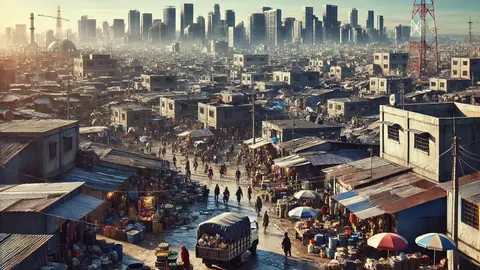
Roy argues that informal housing is not what happens where the state does not reach, but a decision of the state: tolerated here, demolished there, legalised when convenient. Informality is not the absence of rules but rules applied unevenly, and that unevenness is the instrument.
Hence her critique of «subaltern urbanism», which romanticises the endurance of poor neighbourhoods, and her insistence that urban theories written from New York or London do not describe Kolkata or Jakarta well — where most of the planet's urban population lives.
Born in Calcutta and trained at Berkeley, Roy is professor of urban planning and social welfare at the University of California, Los Angeles, where she directs the Institute on Inequality and Democracy. City Requiem, Calcutta (2003) studied how poverty and gender intersect in the settlements of her home city, and her 2005 article on urban informality as an epistemology of planning argued that informality is not the absence of a plan but a mode of governing: the state decides which illegality it tolerates and which it demolishes.
Her 2009 article on new geographies of theory and Worlding Cities (2011, with Aihwa Ong) placed Asian and Southern cities as sources of theory, and Poverty Capital (2010) dismantled microcredit as a solution to poverty. From Los Angeles she researches housing, evictions and what she calls the racial banishment of the poor from American cities, and has carried that research into the housing struggle in the city itself.
Videos on Ananya Roy (2)
- Urban economy
Ananya Roy: The State Can Also Be Informal
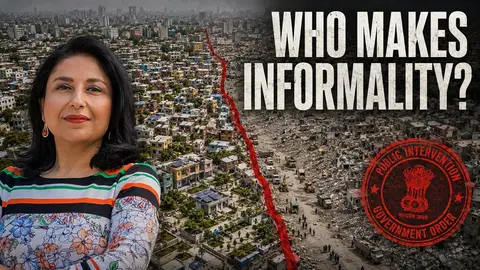
Ananya Roy shows that urban informality is produced by the state as it tolerates, authorises or demolishes…
Ananya Roy 3 min read - Urban economy
Poverty Capital by Ananya Roy: The Critique of Microfinance
Poverty Capital (2010) by Ananya Roy shows how microfinance turned poverty into a market. From Grameen to…
Ananya Roy 2 min read

Where Ananya Roy is cited (19)
- Urban geopolitics
Janet Abu-Lughod: cities, the world system and comparison
Janet Abu-Lughod showed a world system existed before European dominance, and studied Cairo, Rabat and New York…
Janet Abu-Lughod 3 min read - Public space
Why Cities Should Not Be Identical Models: Jennifer Robinson
Jennifer Robinson argues in Ordinary Cities that every city can produce theory and that judging them by the…
Jennifer Robinson 3 min read - Urban economy
AbdouMaliq Simone: People as the Infrastructure of the City
AbdouMaliq Simone shows that informal networks sustain urban life in the Global South: people as infrastructure,…
AbdouMaliq Simone 3 min read - Urban geopolitics
Who Experiments in Our Cities? Pilots and Risk in the Global South
Experimental urbanism tests the cities of the future in the Global South, from Eko Atlantic to India's smart cities…
3 min read - Shrinking cities
Robert Beauregard: Urban Decline and Postindustrial Cities
Robert Beauregard explains in Voices of Decline how the decline of Detroit, Cleveland or St. Louis was at once fact…
Robert Beauregard 3 min read - Urban economy
Tania Murray Li: Development, Exclusion and the Will to Improve
Tania Murray Li explains why development programmes produce exclusion by rendering political problems technical.
Tania Murray Li 3 min read - Urban geopolitics
Urban Geography in the 21st Century: Challenges and New Frontiers
How urban geography has changed: theory beyond the Global North, cities and climate change, technologies of…
2 min read - Urban geopolitics
African Cities by Garth Myers: Reassessing African Cities
African Cities (2011) by Garth Myers proposes reading African cities on their own terms: postcolonial, informal,…
Garth Myers 2 min read - Urban geopolitics
Johannesburg: The Elusive Metropolis by Mbembe and Nuttall
Achille Mbembe and Sarah Nuttall read Johannesburg as a modern African metropolis rather than an exception. The…
3 min read - Urban geopolitics
The Endless City by Burdett and Sudjic: The Global City Compared
The Endless City (2007) by Ricky Burdett and Deyan Sudjic compares with maps and data New York, Shanghai, London,…
3 min read - Urban geopolitics
Peripheral Global Cities: Subordinate Integration and Exclusion
How the cities of the Global South are inserted into the world economy in a subordinate way: Grant and Nijman's…
3 min read - Urban geopolitics
Planetary Urbanization: Neil Brenner and Christian Schmid's Thesis
Planetary urbanization holds that the urban has no outside: mines, plantations and networks are part of the city.
Neil Brenner 2 min read - Urban geopolitics
The Production of Space in the Global South: Robinson and Pieterse
The production of space in the Global South needs its own categories. What Jennifer Robinson (Ordinary Cities). The…
2 min read - Housing
Planet of Slums by Mike Davis: The Global Urban Crisis Explained
Planet of Slums (2006) by Mike Davis explains why more than a billion people live in informal settlements and which…
Mike Davis 3 min read - Urban geopolitics
Urbanization in the Global South: Simone, Pieterse and Roy Explained
Global South urbanization concentrates the world's urban growth without formal jobs or state capacity. What…
3 min read - Urban geopolitics
Postcolonial Urban Fragmentation: Inequality and Resistance
Why postcolonial cities remain divided: Fanon's city, Graham and Marvin's splintering infrastructure, Caldeira and…
3 min read - Public space
Decolonising Urban Space: What It Means and How It Is Done
Decolonising urban space dismantles the hierarchies colonisation left in cities. What Ananya Roy and Jennifer…
3 min read - Urban economy
Informal Economy and Informal Settlements in the Global South
Two billion people work in the informal economy and a billion live in informal settlements. What AbdouMaliq Simone…
3 min read - Urban geopolitics
Jennifer Robinson and Ordinary Cities: Urban Theory from the South
Ordinary Cities (2006) by Jennifer Robinson holds that all cities are ordinary and sources of theory. Her critique…
Jennifer Robinson 3 min read