Manuel Castells
1942
Spanish sociologist who explained the city first as a conflict over public services and later as a node in a world network.
In his early work Castells defined the city by «collective consumption»: schools, transport, healthcare, housing. Things the market does not provide well and that the state has to guarantee. Hence urban conflicts — over a bus route, over a health centre — are political conflicts in the full sense.
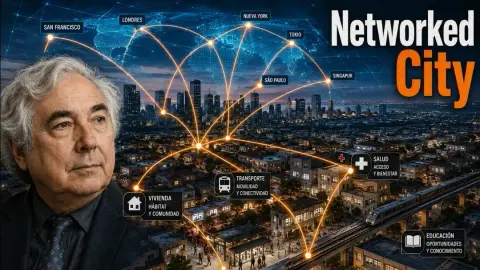
He later turned to the network society and coined the «space of flows»: the idea that what organises territory today is not so much physical proximity as connection. Two financial districts ten thousand kilometres apart work more closely together than a district and the neighbourhood next door.
On Manuel Castells in this archive
- Urban economy
Urban evolution in the digital age
How cities adapt to digital changes through collective consumption, social movements, and network society. Learn…
Manuel Castells 3 min read - Urban AI
Manuel Castells: from neighbourhood struggle to network city
Castells read urban movements as structural responses to power, then showed how information networks reconfigured…
Manuel Castells 3 min read - Urban geopolitics
Space of Flows and Global Cities
The concept of the “Space of Flows” was developed by sociologist Manuel Castells to describe how global cities are…
Manuel Castells 2 min read - Urban AI
Hybrid Urban Spaces: Physical and Digital Convergence
Hybrid urban spaces blend physical and digital elements, reshaping city experiences. Key to understanding modern…
Manuel Castells 2 min read - Public space
Insurgent Citizenship Transforming Cities From The Ground Up
The concept of **“insurgent citizenship,”** developed by James Holston, refers to the ways in which urban…
Manuel Castells 3 min read - Public space
Urban Social Movements: Struggles for Justice and Equity
Urban social movements have emerged as key responses to the economic and social transformations shaping…
Manuel Castells 1 min read