Richard Sennett
1943
American sociologist who has thought of the city as a school for living among strangers, from creative disorder to the open city.
Born in Chicago in 1943 and raised in the Cabrini-Green public housing project, Sennett was a cellist before training at Harvard with David Riesman, and has taught in New York and at the London School of Economics. The Uses of Disorder (1970), his first book, defended urban disorder as a school of maturity against the purified communities of the suburb, and The Fall of Public Man (1977) traced how public life emptied as intimacy became the only value.
Flesh and Stone (1994) travelled the history of the Western city through the body, from naked Athens to the New York of the elevator, and The Corrosion of Character (1998) and The Craftsman (2008) carried his gaze to work. In Building and Dwelling (2018) he summed up half a century of reflection in the distinction between the ville, the built city, and the cité, the way of living it, and proposed an open, porous, incomplete city against the closed city of total plans and gated developments.
He has advised UN-Habitat and worked with Ricky Burdett on the Urban Age programme at the London School of Economics, and his idea that the competence to live among strangers is what the city teaches has influenced public space design. Critics reproach him for a humanism that says little about capital; he answers that without the cité no ville is worth anything.
Videos on Richard Sennett (2)
- Public space
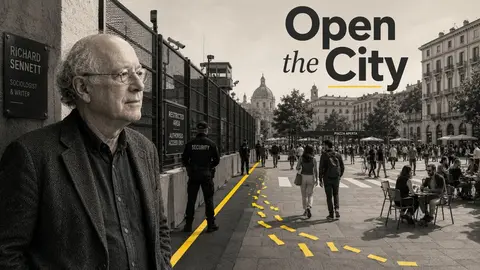
Richard Sennett's Open City: Open or Close the Public Space?
Richard Sennett defends the open city, designed for encounters with strangers, against closed enclosures. Ville and…
Richard Sennett 3 min read - Public space
Richard Sennett and the Decline of Public Life
In The Fall of Public Man (1977) Richard Sennett explains how the tyranny of intimacy emptied public space. Key…
Richard Sennett 3 min read
Where Richard Sennett is cited (3)
- Public space
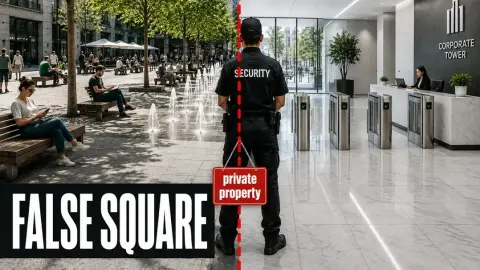
Who Controls Your City's Public Spaces? Private Plazas
Privately owned public spaces look like squares but carry private rules. From New York's 1961 zoning to Occupy,…
3 min read - Urban geopolitics
The Endless City by Burdett and Sudjic: The Global City Compared
The Endless City (2007) by Ricky Burdett and Deyan Sudjic compares with maps and data New York, Shanghai, London,…
3 min read - Public space
Inclusive Public Space: Sennett and Low on Participatory Cities
Inclusive public space is the infrastructure of urban democracy. What Richard Sennett and Setha Low explain, two…
3 min read