Key points
- Hayden shows that separating home and work was a project that assumed a woman at home, and that urban memory excludes too.
- Kern traces inequality from the body: pushchairs, night-time fear and intersectionality.
- Transport, safety, services and public space concentrate the inequalities; Vienna and Barcelona show how to correct them.
Gender inequality in urban space is the systematic difference in how women and men can use, move through and feel safe in the city, and it is measured in time, money, fear and opportunity. Mobility surveys show that women make more short, chained trips, more on foot and by public transport and fewer by car; victimisation surveys, that most have suffered harassment in the street or on transport; and time-use surveys, that they devote twice as many hours to care. Two authors have explained why the city produces those differences: Dolores Hayden, from the history of design and urban memory, and Leslie Kern, from everyday experience and feminist geography.
Dolores Hayden: design, memory and the power of place
Hayden showed in The Grand Domestic Revolution (1981) and Redesigning the American Dream (1984) that the separation of home and work, of residential neighbourhood and employment centre, was not an accident but a project that assumed a woman at home. In The Power of Place (1995) she added the symbolic dimension: a city that commemorates only powerful men, with its statues, street names and buildings, teaches its inhabitants who has counted in its history. Hayden documented in Los Angeles the memory of women workers, Black communities and migrants through plaques and walking routes, arguing that recognition in space is part of equality.
Leslie Kern: inequality lived from the body
Kern, in Feminist City (2019), traces inequality from the body. The city of moms reveals every kerb, every metro staircase without a lift and every café with no room for a pushchair. The city of fear shows how the threat of violence, though statistically concentrated in the home, is projected onto parks, alleys and night-time bus stops and cuts women's freedom of movement more than any physical barrier. Kern insists on intersectionality: the migrant woman cleaning offices before dawn, the Black woman stopped by police or the disabled woman without a lift live specific inequalities that no single category explains.
Mobility, safety, services and public space: four inequalities
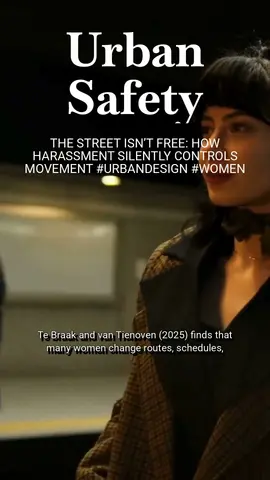
The concrete inequalities fall into four areas. Mobility: transport networks designed for the home-to-work commute, with low frequencies outside the peak hours when care trips are made, and per-trip fares that penalise chained journeys. Safety: lighting, visibility and the presence of people that determine which streets are avoided and at what hour. Services: nurseries, schools, health centres and shops located far from housing, which turn every task into a journey. And public space: parks and sports pitches occupied by boys, benches without shade, an absence of public toilets that limits how long an older or pregnant woman can spend outside.
Vienna, Barcelona, Bogotá: responses and debates
Responses have been tried. Vienna has applied everyday-life urbanism since 1992, with gender audits on every project, parks redesigned for girls and housing with shared services. Barcelona built a gender perspective into its superblocks and runs exploratory walks with local women to identify places of fear. Mexico City and Bogotá segregated metro and bus carriages as an emergency measure against harassment, amid debate over whether they protect or normalise exclusion. Umeå built a pedestrian tunnel designed by women, and dozens of cities have changed transport fares and timetables after measuring care trips.
Hayden and Kern agree that gender inequality in the city is not corrected with add-ons, more light here, a carriage there, but by changing who decides and what is measured. As long as mobility data do not count care trips, planning tables do not include diverse women and urban memory speaks only of men, the city will keep producing the inequality it claims to fight. The city that works for those who care, walking, with children or at night, works better for everyone.
Frequently asked questions
How does gender inequality show up in the city?
In a mobility of short, chained trips that transport does not serve, in the fear that limits which streets and hours women use, in care services far from housing and in public space occupied by boys and lacking toilets and shade.
What does Dolores Hayden propose in The Power of Place?
That urban memory, statues, street names and commemorated buildings, teaches who has counted in the city's history, and that recognising women workers, Black communities and migrants in space is part of equality.