Key points
- Kern organises the book into six cities: of men, of moms, of friends, of one, of protest and of fear.
- The pushchair reveals the city: every kerb and metro staircase is an obstacle that no plan measures.
- More police and cameras raise control without reducing fear; visibility, activity and night transport do.
Feminist City: Claiming Space in a Man-Made World (2019) is the book with which the Canadian geographer Leslie Kern, a professor at Mount Allison University, carried feminist urbanism from academia into public debate. Her thesis is that the city has been designed by and for a default man, and that this inheritance shows in every detail: the height of bus steps, the absence of public toilets, the lighting of parks, transport timetables. Kern writes from experience, as a mother, a researcher and a woman who walks alone at night, and organises the book into six cities that are really six ways of inhabiting the same one.
The city of men and the city of moms
The city of men is the diagnosis. Kern shows how modern planning separated housing from employment on the assumption of a woman at home, and how the city of skyscrapers, highways and monuments to great men celebrates a masculine power that still decides what gets built. The city of moms is the first practical test: with a pushchair, every kerb, every metro staircase and every café without space becomes an obstacle, and the care work that sustains the city appears in no plan and no mobility statistic.
Friends, solitude and protest: three ways of inhabiting the city
The city of friends reclaims networks among women, from those who shared flats and care in industrial cities to those who organise today in neighbourhood WhatsApp groups, as real urban infrastructure that planning ignores. The city of one, that of the woman alone in public space, examines the pleasure and the risk of walking, sitting or eating without company, and the constant vigilance it demands. The city of protest runs from the suffragettes to Ni Una Menos to show that occupying the street has always been how women claimed rights.
The city of fear and the critique of surveillance
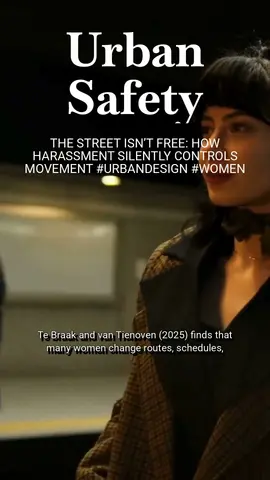
The central chapter is the city of fear. Kern documents how the threat of sexual violence, real and statistically concentrated in the home, is projected onto public space and limits women's freedom of movement more than any physical barrier. She criticises the usual response, more police and more cameras, which increases control without reducing fear and punishes racialised men, and proposes design with visibility, activity on the street, reliable night transport and a culture that stops blaming the victim. Her analysis is intersectional: fear and risk are not the same for a white woman, a Black woman, a trans woman or a woman with a disability.
The city of possibility: feminist alternatives
The city of possibility closes the book with the alternatives: housing cooperatives with shared care, gender-sensitive participatory budgets, public transport designed around the chained trips of care work, public spaces planned with girls and teenagers, and the demand that women, in all their diversity, sit at the tables where the city is decided. Kern cites Vienna, Barcelona and Toronto as places where some of that already happens, and Dolores Hayden and Jane Jacobs as forerunners.
Kern's contribution is one of method as much as content: starting from everyday experience, her own and others', to discover how the city decides which bodies are welcome. Her later book, Gentrification Is Inevitable and Other Lies (2022), applies the same lens to displacement. Feminist City has turned a generation of readers into critical observers of their streets, which is the first step toward changing them.
Frequently asked questions
What is Feminist City by Leslie Kern about?
It analyses how the city has been designed by and for a default man and how women experience it as mothers, friends, women alone, protesters and people who feel fear, and proposes alternatives from feminist and intersectional urbanism.
What does Kern propose against fear in public space?
She rejects the response of more police and cameras, which does not reduce fear and punishes racialised men, and proposes design with visibility, street activity, reliable night transport and a culture that stops blaming the victim.