Public transport
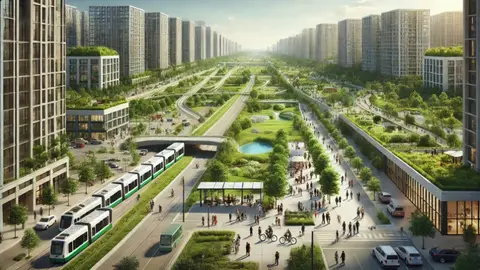
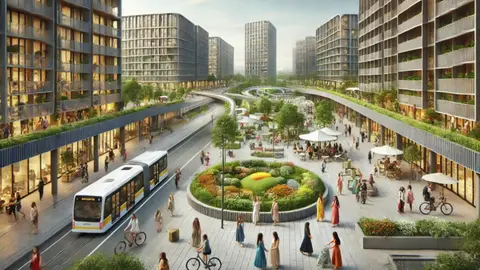
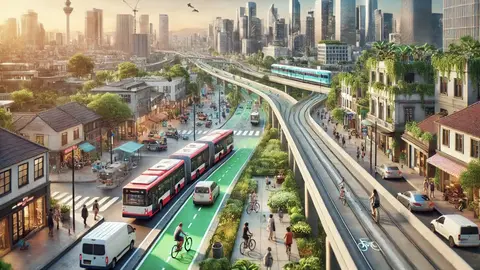
Public transport is the network of buses, trams, metros and trains that moves many people in little space: a bus lane carries five to ten times more people per hour than a car lane. Its quality —frequency, coverage, fares— decides job access for those who do not drive.
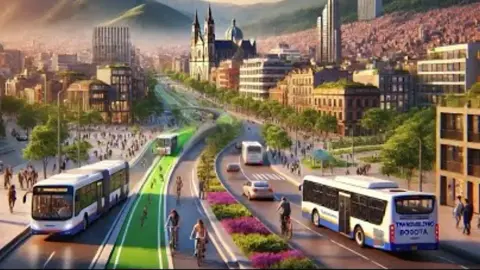
Curitiba invented high-capacity bus rapid transit in the 1970s and Bogotá scaled it with TransMilenio; Santiago learned with Transantiago that redesigning the whole network at once carries an enormous political cost. The recent debate is free fares: Tallinn, Luxembourg and Kansas City tried it with mixed results.
Videos on this term (51)
- Public space
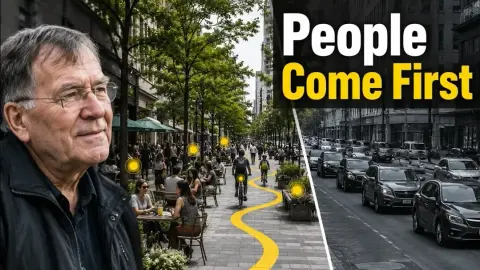
Why Walking Makes Cities Livelier and Safer: Jan Gehl's Evidence
Walking is the basis of public life and safety. What Jan Gehl measured in Cities for People, his twelve quality…
Jan Gehl 3 min read - Urban form
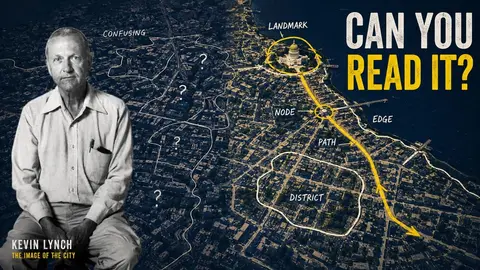
How Five Elements Make a City Legible and Accessible
Kevin Lynch's five elements, paths, edges, districts, nodes and landmarks, explain how people read a city, and…
3 min read - Shrinking cities
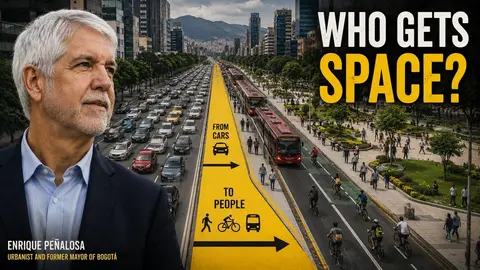
Who Deserves Space in the City? Peñalosa and the Fair Street
Enrique Peñalosa turned the distribution of urban space into a policy of equality: pavements, cycle paths,…
3 min read - Housing
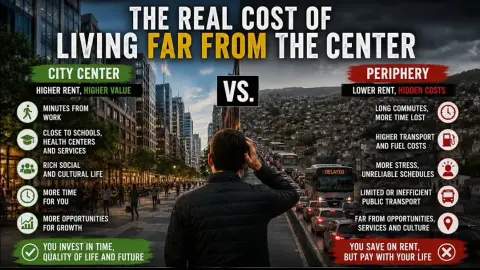
The Real Cost of Living Away: More Than Rent
Cheap housing on the outskirts is paid in bus hours, fuel, care and lost opportunities: the H+T index, Carlos…
3 min read - Mobility
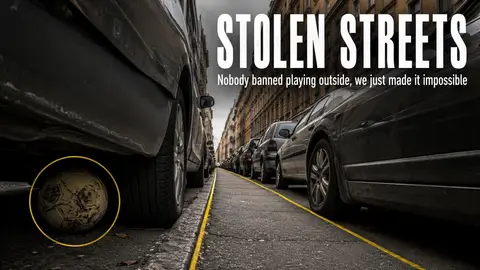
Traffic and Fear Kept Our Children Confined at Home
From eight in ten children walking to school alone to one in ten: how the car expelled children from the street,…
3 min read - Urban economy
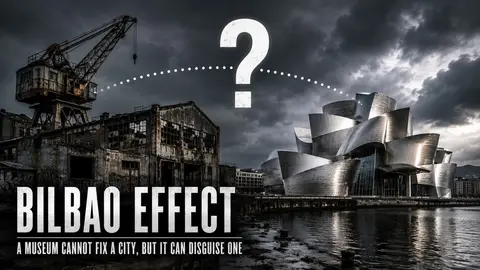
Guggenheim Versus the Rest: Myths and Realities of Iconic Museums
Why the Guggenheim effect worked in Bilbao and failed when copied: the prior plan, Beatriz Plaza's data, the…
3 min read - Urban economy
Who Pays When a Mega-Project Fails? Public Risk and Private Gain
Mega-projects are built on public decisions and public money, yet gains go private and losses stay public.
3 min read - Housing
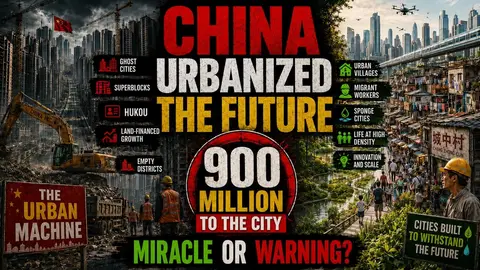
Chinese Urbanization: Land, Superblocks, Hukou and Ghost Cities
Chinese urbanization moved more than 900 million people into cities in four decades. How land sales, superblocks,…
3 min read - Urban psychology
Juhani Pallasmaa: The Eyes of the Skin and the senses
A summary of Juhani Pallasmaa's The Eyes of the Skin: why modern architecture privileges sight, and what touch,…
Juhani Pallasmaa 2 min read - Urban psychology
Kevin Lynch's The Image of the City: How We Perceive Cities
The Image of the City (1960) by Kevin Lynch explains how we perceive cities through five elements: paths, edges,…
Kevin Lynch 3 min read - Public space
Marc Augé: what non-places are
What non-places are according to Marc Augé: airports, motorways and shopping malls without history or identity,…
Marc Augé 2 min read - Urban form
Jaime Lerner: the urban acupuncture of Curitiba
Lerner argues that one small, well-placed intervention transforms a whole neighbourhood. He proved it as mayor of…
Jaime Lerner 2 min read - Urban geopolitics
Edgar Pieterse: Spatial Justice and Sustainable Cities in Africa
Edgar Pieterse of the African Centre for Cities proposes radical incrementalism for African cities: improving the…
Edgar Pieterse 3 min read - Urban history
Divided Berlin: The History of a Fractured City, 1945-1989
Berlin Divided City, edited by Philip Broadbent and Sabine Hake, explains how the Cold War produced two Berlins.…
Philip Broadbent 3 min read - Urban geopolitics
City Politics by Judd and Swanstrom: Power and Urban Governance
City Politics by Dennis Judd and Todd Swanstrom explains how US cities are governed: private power, growth…
2 min read - Urban geopolitics
Shanghai as a Global City: From the Concessions to Pudong
Shanghai went from an open port in 1843 to a cosmopolitan metropolis and, after 1990, to a state-directed global…
3 min read - Urban history
Robert Caro and Robert Moses: The Legacy of The Power Broker
The Power Broker, by Robert Caro, tells how Robert Moses transformed New York without ever being elected: parks,…
Robert Caro 3 min read - Urban form
Peter Calthorpe and The Next American Metropolis: The Origin of TOD
The Next American Metropolis (1993) by Peter Calthorpe formulated transit-oriented development against the…
Peter Calthorpe 2 min read - Public space
Women and Cities: Advances and Gaps in Urban Research
A review of 275 articles from 1977 to 2019 shows what urban research knows about women and cities and what it…
2 min read - Public space
Ana Falú: Feminist Urbanism and Inclusion in Cities
Ana Falú, a reference of feminist urbanism in Latin America: urban safety from a gender perspective, women's…
Ana Falú 2 min read - Mobility
Enrique Peñalosa and the Transformation of Bogotá (1998-2000)
Enrique Peñalosa transformed Bogotá between 1998 and 2000 with TransMilenio, cycle paths, pavements and libraries…
3 min read - Public space
Richard Sennett and the Decline of Public Life
In The Fall of Public Man (1977) Richard Sennett explains how the tyranny of intimacy emptied public space. Key…
Richard Sennett 3 min read - Mobility
The Right to Mobility: Social Justice in Urban Transport
The right to mobility is the right to get there, not to move. What David Harvey and Susan Handy explain, what…
3 min read - Infrastructure
Urban Infrastructure, Power and Inclusion: Star and Larkin Explained
Urban infrastructure decides who belongs to the city. What Susan Leigh Star and Brian Larkin propose, Graham and…
3 min read - Shrinking cities
Postindustrial Cities: How They Reinvent Themselves and Who Wins
Postindustrial cities replaced factories with services, culture and technology. What David Harvey, John Friedmann…
2 min read - Public space
Edward Soja and Spatial Justice: The City After Chicago
Edward Soja defined spatial justice: geography produces injustice and changing space is doing justice.…
Edward Soja 2 min read - Public space
Dolores Hayden and Feminist Urbanism: The Grand Domestic Revolution
Dolores Hayden showed that housing and cities were designed as if care work did not exist. What The Grand Domestic…
Dolores Hayden 2 min read - Public space
Jane Jacobs: the street as the engine of the city
Jane Jacobs showed in 1961 that mixed uses, density and active streets keep a neighbourhood safe better than any…
Jane Jacobs 2 min read - Urban geopolitics
The Endless City by Burdett and Sudjic: The Global City Compared
The Endless City (2007) by Ricky Burdett and Deyan Sudjic compares with maps and data New York, Shanghai, London,…
3 min read - Public space
Feminist City by Leslie Kern: The City Made by and for Men
Feminist City (2019) by Leslie Kern shows how the city was designed for a default man and how mothers, women alone…
Leslie Kern 2 min read - Mobility
Transit-Oriented Development: Cervero and Newman
Transit-oriented development builds dense, mixed-use neighbourhoods around stations: Cervero's transit metropolis,…
2 min read - Urban geopolitics
Racial inequality and spatial segregation in the city
How race structures the city: Wacquant (Urban Outcasts), Elijah Anderson and Ruth Glass on segregation,…
2 min read - Public space
Gender Inequality in Urban Space: Causes and Responses
Gender inequality in the city is measured in time, fear and opportunity. What Dolores Hayden and Leslie Kern…
3 min read - Mobility
Shared Mobility in Cities: What Works According to Shaheen and Cervero
Shared mobility cuts cars only if the city governs it. What Susan Shaheen and Robert Cervero measure about car…
3 min read - Public space
Pedestrianization: Definition and Benefits from Gehl and Appleyard
Pedestrianization gives the street back to people. What it is, how Jan Gehl and Donald Appleyard justify it and…
3 min read - Mobility
Mobility as a Service (MaaS): Whim's Promise, Failure and What Works
Mobility as a Service integrates public transport, bikes and taxis in one app. What Whim promised in Helsinki, why…
3 min read