Height and skyscrapers
Height is the most visible and least decisive dimension of urban form: a skyscraper concentrates floor area on little land, but surrounded by emptiness it yields less density and less life than a six-storey block. Building tall is an economic —land rent— and symbolic decision before it is a necessity.
The skyscraper was born in Chicago in the 1880s thanks to the lift and steel, and today it is above all a financial and image product: the half-empty luxury residential tower is the built form of financialisation. Height regulation, so hotly debated, matters less than the regulation of uses and site coverage.
Videos on this term (9)
- Urban geopolitics
Rem Koolhaas: Manhattanism, Bigness and the Generic City
Rem Koolhaas explains what happens when the city grows faster than the planner's control: Manhattanism, Bigness,…
Rem Koolhaas 3 min read - Urban geopolitics
Who Experiments in Our Cities? Pilots and Risk in the Global South
Experimental urbanism tests the cities of the future in the Global South, from Eko Atlantic to India's smart cities…
3 min read - Housing
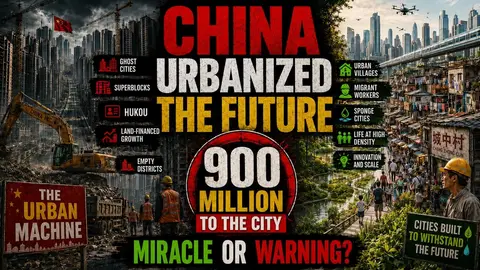
Chinese Urbanization: Land, Superblocks, Hukou and Ghost Cities
Chinese urbanization moved more than 900 million people into cities in four decades. How land sales, superblocks,…
3 min read - Urban form
Rem Koolhaas: Delirious New York and the Culture of Congestion
Delirious New York, Rem Koolhaas's retroactive manifesto: the culture of congestion, Rockefeller Center as a city…
Rem Koolhaas 2 min read - Urban form
Vertical by Stephen Graham: The City from Satellites to Bunkers
Stephen Graham shows in Vertical that the city is a volume: skyscrapers and drones above, tunnels and bunkers…
Stephen Graham 3 min read - Urban geopolitics
Hong Kong as a Global City: Stephen Chiu and Tai-lok Lui
Stephen Chiu and Tai-lok Lui explain how Hong Kong went from colony to global financial centre and what that means…
Stephen Chiu 3 min read - Urban geopolitics
Shanghai as a Global City: From the Concessions to Pudong
Shanghai went from an open port in 1843 to a cosmopolitan metropolis and, after 1990, to a state-directed global…
3 min read - Urban economy
Urban Fortunes by Logan and Molotch: The City as a Growth Machine
Urban Fortunes (1987) by John Logan and Harvey Molotch explains who rules cities: the coalition that gains from…
3 min read - Urban geopolitics
Saskia Sassen: Cities in a World Economy
A summary of Saskia Sassen's Cities in a World Economy: why a handful of cities concentrate command over the global…
Saskia Sassen 2 min read