Key points
- Wolch proposed zoopolis: a city planned for the animals that already live in it.
- Donaldson and Kymlicka split urban animals into domesticated, liminal and wild.
- Green bridges, hollow bricks and visible glass are concrete measures, not metaphors.
Look out the window of any city. A pigeon lands on a wire. A rat slips over the edge of a drain. A fox walks at night through an empty park. A hawk nests on the ledge of a tower. Nobody invited them, yet there they are. We build the streets as if only we lived here. And still, every corner is full of non-human life. Some animals have even turned nocturnal to avoid us. They come out while we sleep, because the day belongs to us. The city is their habitat, though it was designed against them. And here a strange question appears. What if we designed cities for them too? That idea has a name. It is called Zoöpolis, the non-human city.
The term was coined by the geographer Jennifer Wolch. She sees a problem in how we think about cities. We design them in an anthropocentric way, meaning only for humans. Nature is left as scenery or as nuisance. Wolch pushes further with an uncomfortable idea. Our distance from animals is not natural. It is built into the very structure of the city. Streets, buildings and the economy separate us from the living. Against that, Wolch imagines something else. A city where many species live together and belong. Not a zoo, but a shared place. The city, Wolch suggests, could also be their home. The Zoöpolis does not cage animals. It learns to live with them.
Zoopolis: three groups of animals
Other thinkers took the idea into politics. Sue Donaldson and Will Kymlicka wrote a key book. They ask what rights animals have over the city. And they propose three broad groups. First, the domestic ones, like the dog or the cat. We brought them home, so they would be almost citizens. Second, the liminal ones, like the pigeon or the fox. They live among us uninvited, like silent neighbors. Third, the wild ones, who hold their own territory. In their world, they rule, not us. This scheme completely changes the view. The animal stops being a pest or property. It becomes someone with a place and rights. Justice, they say, should not stop at our species.
Look at the middle group, the most awkward one. The rat and the pigeon feel like enemies to us. We launch campaigns to wipe them out entirely. Donaldson and Kymlicka make a harsh comparison here. They say these wars recall the purges of unwanted populations. The idea stings, but it forces us to think. Those animals invaded nothing. They adapted to the city we ourselves built. Our food scraps attract them. Our buildings give them shelter. In a sense, they are refugees of our own world. They did not come against the city. They came because of it. Treating them only as pests hides that responsibility.
Why the city suits them
Before redesigning anything, it helps to understand why they come. The city is not a bad place to live if you are small. It runs several degrees warmer than the countryside around it, especially at night. That heat lets species winter here that could not before. There is constant, predictable food, on schedules that can be learned. An urban fox knows which day the bins go out on its street. And there are far fewer large predators than in a forest. Office towers also work as artificial cliffs. That is why the peregrine falcon, once a bird of crags, now nests on skyscrapers. It has not come to the wrong place. It has found a cliff with pigeons included. None of this is an anomaly. It is what any species with options would do.
And the city does not merely host them. It is also changing them. The biologist Hans Slabbekoorn compared the song of great tits across several cities. Urban birds sing at a higher pitch, because low notes are lost under traffic noise. A global analysis of camera traps found something similar in mammals. Near human activity they become roughly a third more nocturnal. The biologist Kristin Winchell measured lizards in San Juan, Puerto Rico. City ones have longer limbs and larger pads on their toes. They grip glass and concrete better than their relatives in the forest. This is no longer only a change of behaviour. It is evolution running at the speed of a building site.
That adjustment has a price, and they pay it. The ornithologist Daniel Klem has spent decades on an almost invisible problem. Birds do not see glass. They see the reflection of sky or trees, and fly into it. Estimates run into hundreds of millions of birds a year in the United States alone. They do not die in spectacular accidents, but one by one, against windows. Night lighting does something similar to insects. Street lamps draw them in and exhaust them until they drop. And they disorient migrating birds that navigate by the stars. None of this was decided. It is the side effect of two materials we happen to love. Marking the glass and switching off what nobody uses would go a long way.
Green bridges, hollow bricks and visible glass
So how do you build a city like that? The answer is more concrete than it seems. There are green bridges so animals can cross the motorways. There are bricks with hollows where swifts and bats can nest. You can leave ponds, hedges and dark corners. You can use glass that birds do not mistake for the sky. You can switch off lights that disorient insects at night. Some call this animal-aided design. The philosopher Donna Haraway sums it up well. We become who we are through other species. Under that view, the garden is not a luxury. It is a way of sharing the ground. Designing with animals, and not only for us, changes the whole city.
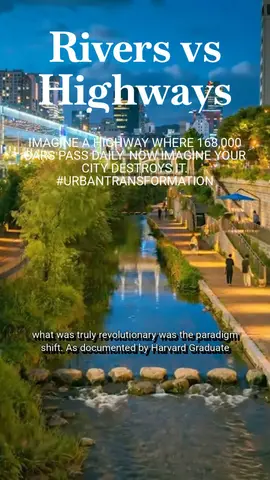
There is one inhabitant we tend to forget completely. Water. Almost every city grew over streams that were later buried. A vault was laid over them and they ended up as sewers. But the river is still down there, and it still gives orders. It sets where the streets curve and where every storm floods. Seoul ran the opposite experiment about two decades ago. It tore down an elevated motorway and uncovered the stream running underneath. Summer temperatures in the area dropped by several degrees. Fish, insects and birds returned after generations away. And the traffic that used that motorway did not fully reappear somewhere else. Digging up a river turned out to be a mobility decision too.
The idea can stretch even further. What if we do not speak only of animals? The legal scholar Christopher Stone asked a famous question. Should trees have rights before the law? It sounded absurd, but the seed grew. Today some rivers are recognized as legal persons. Someone can defend them in court, like a citizen. The Zoöpolis becomes a wider community. Not only of people, but of living beings with a voice. The river, the tree and the animal stop being things. They start to be part of the city's political body. They are no longer a backdrop, but an actor. It is a huge shift in who counts as a subject.
Serious objections and how to measure it
We should, however, hear the serious objections. Is all this not too romantic? The city protects people from disease and danger. Someone must decide when an animal is a real threat. Giving rights to rats sounds, to many, like madness. And there is a subtler risk too. Sometimes beautifying nature raises the prices of a neighborhood. The new park can push out the poorest residents. So the green city becomes an exclusive city. But anthropocentrism also carries a huge cost. Sterile cities, collapsing biodiversity and a deep loneliness. Between controlling nature and living with it lies a real tension.
And if we are serious about this, we need to be able to measure it. The researcher Cecil Konijnendijk proposed a rule that is easy to remember. Three trees visible from every home. Thirty percent canopy cover in every neighbourhood. And a decent park within three hundred metres of your door. The beauty of it is that anyone can check it from their own window. And when people check, the same pattern shows up every time. The neighbourhoods with the fewest trees are the ones with the lowest incomes. In several cities, the map of shade looks like the old map of discrimination. Those streets now run several degrees hotter than the wealthy centre. Urban biodiversity is not an ornament. It is also a question of distribution.
So let us return to the opening question. What if we designed cities for animals too? Perhaps the question is not only about them. It is about admitting something we forget. The city was never only ours. We always shared it with thousands of other lives. The Zoöpolis does not ask us to give up the human. It asks us to widen the circle of who we call neighbor. Recognizing the other does not make us less human. Maybe a good city is not measured only by us. It is measured by how much room it leaves for what we are not. The pigeon on the wire already lives here. The question is whether we still see it as an intruder.
Frequently asked questions
What is a zoopolis?
The city planned for the animals that already live in it, proposed by the geographer Jennifer Wolch against a planning tradition that serves human needs alone.
Which measures make a city more liveable for wildlife?
Green bridges over motorways, bricks with hollows for swifts and bats, glass with visible markings for birds, buried rivers brought back to the surface, and enough tree canopy.