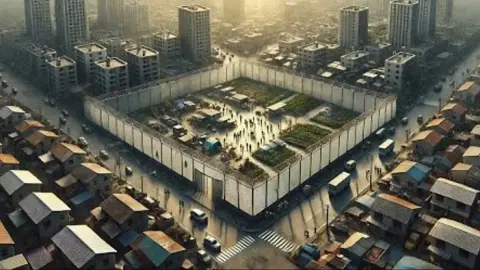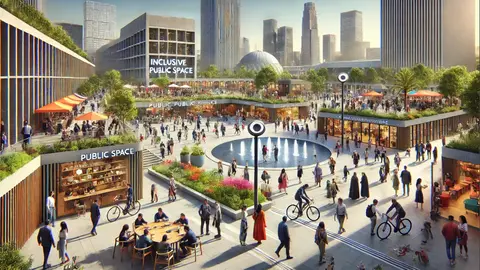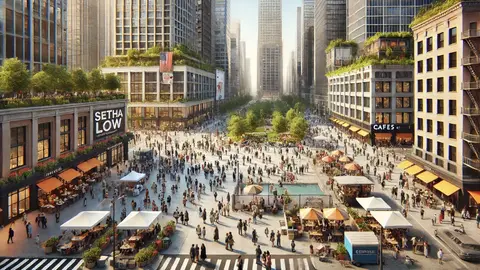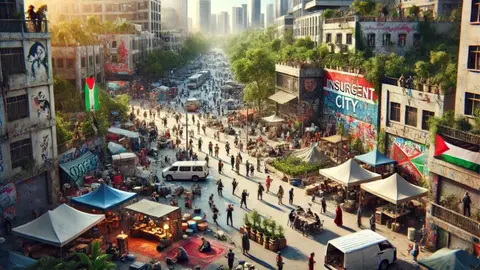
Public space is the ground of the city that belongs to nobody in particular and therefore to everyone: streets, squares, parks, promenades, markets, steps and waterfronts. It is where the city becomes visible to itself, where strangers cross paths, where people protest, play, sell and wait. It is also the most contested space: every metre of street that goes to the car, the paid terrace or the fence of a shopping centre stops being available for everything else.
This guide gathers what research and the experience of cities know about public space: what makes one plaza work and another empty out, according to William Whyte, Jan Gehl and Jane Jacobs; how it is privatised without anyone noticing; what hostile design is; why public space is not the same for women, children, the elderly and people with disabilities; what tactical urbanism and superblocks contribute, and what lessons Copenhagen, New York, Barcelona, Medellín or Bogotá have left. At the end it links the channel's videos on public space, street life, urban psychology and accessibility.
What public space is and why it matters
In the strict sense, public space is publicly owned, freely accessible land: the street, the square, the park. In the broad sense, it is any place where anyone can be without paying or asking permission, which is why the discussion also includes lobbies, shopping centres, stations or privately owned plazas in public use. What defines public space is not the title deed but three conditions: that it be accessible to all, that it allow unprogrammed uses and that in it one can see and be seen by strangers.
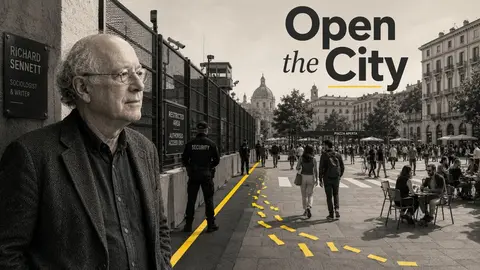
It matters for reasons beyond leisure. Jane Jacobs showed in 1961 that the safety of a street comes not from police or cameras but from eyes on the street, the natural surveillance of neighbours, shopkeepers and passers-by that exists only where there are reasons to be there. Richard Sennett described the city as the place where we learn to live with those unlike us, and that education happens only in shared spaces. And public health has measured that those who live near parks and walkable streets walk more, weigh less and suffer less depression.
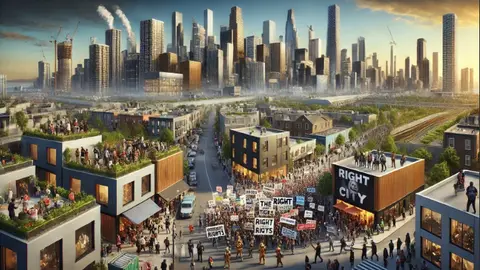
Public space is also the stage of politics: from the Greek agora to Madrid's Puerta del Sol in 2011, from Tahrir Square to every Saturday's demonstrations, democracy needs a place to gather that nobody can close. Don Mitchell summed it up in The Right to the City (2003): public space does not exist in advance, it is won every time a group uses it to become visible, and lost every time it is closed on the excuse of order, cleanliness or security.
What makes a plaza work: Whyte, Gehl and Jacobs
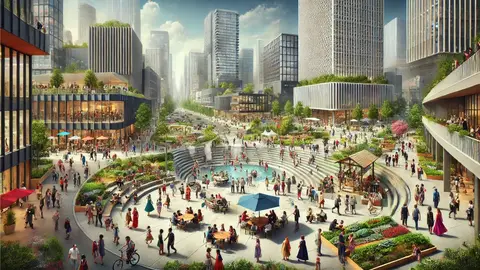
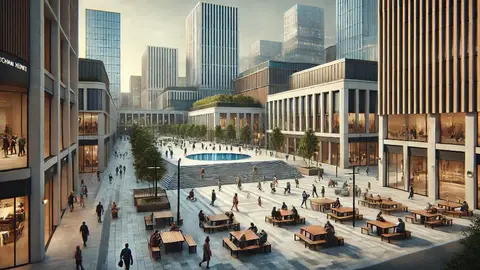
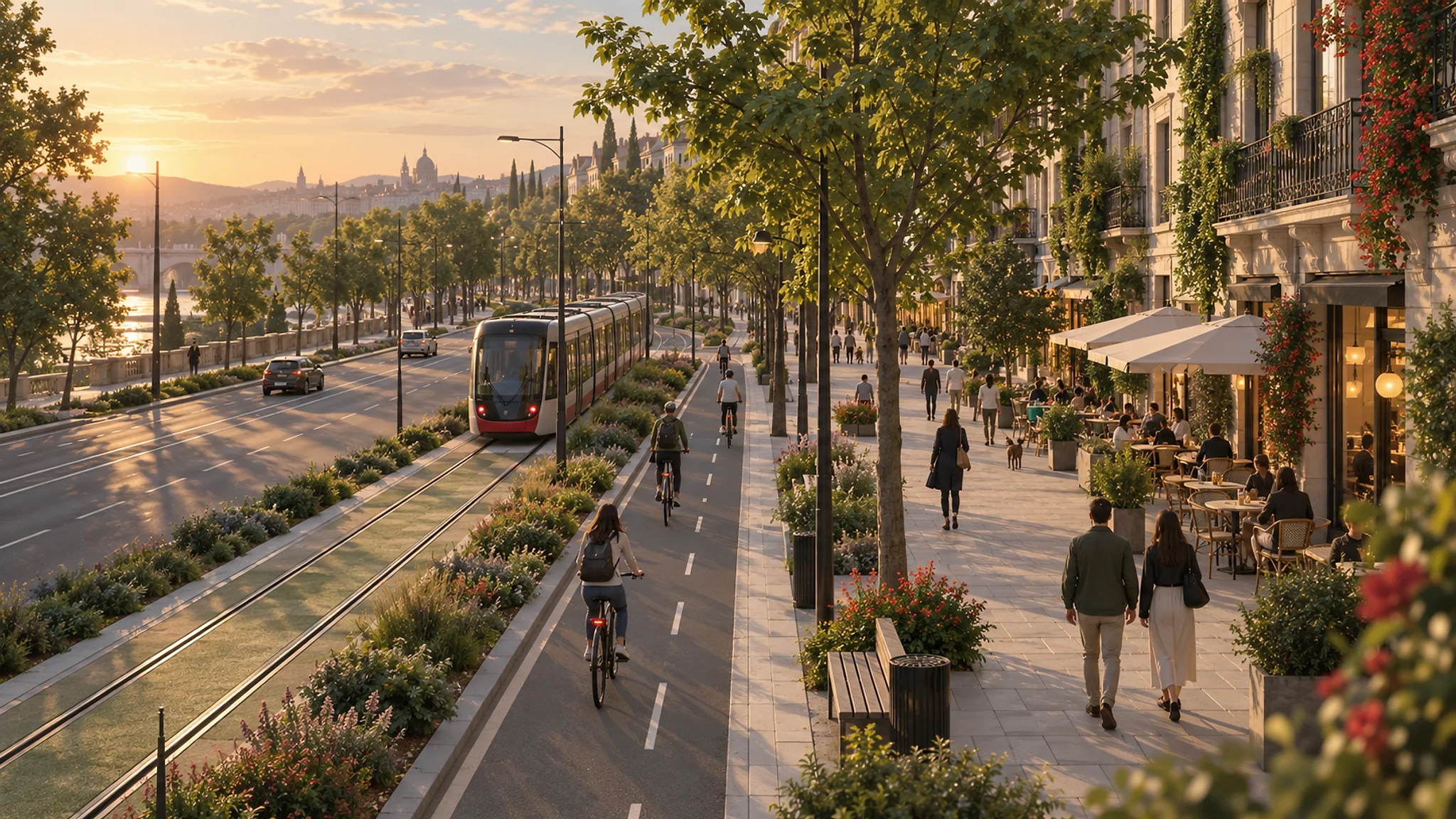
William H. Whyte spent the 1970s filming New York plazas in time-lapse to learn why some filled up and others, a few metres away, stayed empty. His conclusions, published in The Social Life of Small Urban Spaces (1980), remain the manual: people sit where there are places to sit, and what is most lacking is seating; the best places have sun in winter and shade in summer, trees, water you can touch and food nearby; the corner where the plaza meets the street is its liveliest part, because people stay at the edge of the flow, not far from it; and what attracts people most is other people.
Whyte also discovered triangulation: a musician, a sculpture or a food cart make two strangers talk to each other, and those stimuli turn a space into a place. His findings changed New York's zoning in 1975, which since then requires privately owned public plazas to have seating, trees and access from the pavement. Jan Gehl reached the same point from Copenhagen with Life Between Buildings (1971): he distinguished necessary activities, going to work, from optional ones, strolling or sitting, and social ones, which grow out of the first two, and showed that only in a good space do the optional and social ones grow.
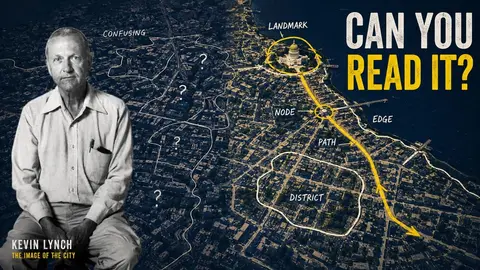
From Jacobs comes the rest: the street needs mixed uses to have people at different hours, short blocks so there are corners and crossings, buildings of different ages so there are cheap rents, and density so all of the above has customers. The three lessons agree on a method: look and count before designing. Gehl turned it into a profession, the public life studies that cities around the world now commission, and into a rule: life first, then space, then buildings.
The privatisation of public space
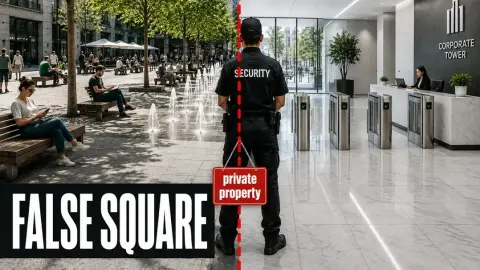
Public space is privatised in several ways, and almost none of them consists of selling a square. The most visible is the shopping centre, which reproduces the street under a roof with guards, opening hours and the right of admission, and which Michael Sorkin described in Variations on a Theme Park (1992) as the city turned into a theme park. The quietest is the privately owned public space, the POPS: New York has more than five hundred, obtained in exchange for extra floor area, and Jerold Kayden found in 2000 that half did not meet the access and seating conditions the city had required of them.
Anna Minton documented in Ground Control (2009) the British model: entire centres, such as Liverpool One or Canary Wharf, with streets that look public but have an owner, a rulebook and private security that can expel anyone who photographs, protests or simply does not consume. Business improvement districts, BIDs, financed by traders, extend that control to streets that are public. And the bar terrace, which in Spanish cities already occupies much of the squares, is the most everyday privatisation: public space rented by the metre to whoever can pay for it.
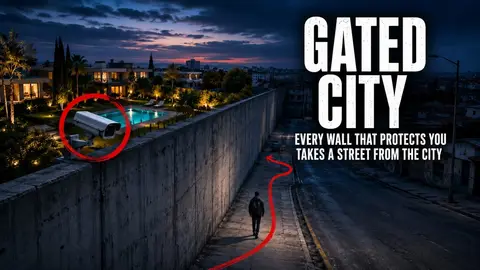
The problem is not ownership but exclusion. A market or a terrace bring life to a square; the problem begins when commercial use leaves no room for those who do not buy, when the rulebook forbids what the law allows and when design decides who is welcome. Cities' response has been to regulate: New York has required since 2017 that every POPS be signposted with its hours and rights; London is debating a code for privately owned public spaces, and many Spanish cities cap the area of terraces.
Hostile design: when the city decides who is surplus
Hostile design or defensive architecture is the set of devices that prevent unwanted uses of public space without forbidding them: benches with armrests in the middle so nobody can lie down, spikes on window sills, bollards under bridges, night-time sprinklers, blue light in toilets so veins cannot be seen, high-pitched sounds only the young can hear. The Camden bench, installed in London in 2012, is the textbook example: a piece of concrete on which one cannot sleep, skate, paint or leave anything.
Its stated aim is safety and cleanliness; its effect is to expel homeless people, teenagers and anyone who wants to stay longer than planned. The anti-homeless spikes at a London doorway provoked a protest in 2014 that forced their removal, and since then collectives and journalists have catalogued them in dozens of cities. What they reveal is an idea of public space as a place of passage, not of staying, and a political decision disguised as furniture.
The alternative is not to stop designing but to design for every legitimate use: benches one can lie on, fountains, public toilets, shade, and social services for those who live on the street instead of furniture that moves them to the next corner. The cities that have removed hostile design, such as some in France after the campaigns of 2020, have not seen disorder grow: they have seen people come back.
Public space for everyone: gender, childhood, age and accessibility
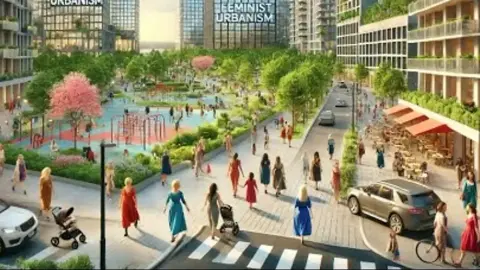
Public space has been designed for a century from the experience of an adult male, healthy, with a car and no care duties. For everyone else it works worse. Women make more short, chained trips, on foot and by public transport, carrying shopping and children, and avoid at certain hours poorly lit streets, underpasses and parks without exits. Vienna has applied since the 1990s, with Eva Kail, a gender perspective to planning: wider pavements, lighting, stairs with ramps, parks with areas for teenage girls, and the Barcelona collective Punt 6 has turned that gaze into an audit method.
Children have disappeared from the street in two generations. Francesco Tonucci measured it in Italy and proposed from 1991 in Fano the city of children: that a six-year-old can walk alone to school is the best test that a city works, and the school routes of Pontevedra or Barcelona, school streets closed to traffic at drop-off and pick-up times and squares with free play rather than only fenced swings go in that direction. Older people need the same under another name: benches every hundred metres, toilets, shade, enough time at traffic lights and pavements without obstacles.
Universal accessibility is the condition of all of the above. The 1990 American law that required kerbs to be lowered produced the curb-cut effect: the ramps designed for wheelchairs are used by pushchairs, suitcases, bicycles and delivery workers. What is accessible for a person with a disability is more comfortable for everyone, and the measure of a good public space is the person who has it hardest: if they can use it, everyone can.
Tactical urbanism, superblocks and placemaking
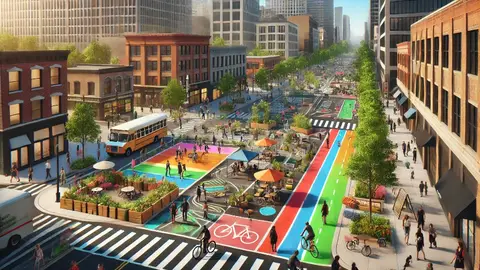
Tactical urbanism is the quick, cheap and reversible transformation of public space to test before building: paint, planters, benches and bollards instead of construction. Its origin lies in citizen actions such as San Francisco's Park(ing) Day in 2005, when a collective rented a parking space and laid turf and a bench, and its consecration in New York in 2009, when Janette Sadik-Khan closed Times Square to traffic with paint and beach chairs as a six-month trial. Pedestrians increased, crashes fell and the closure became permanent. Mike Lydon and Anthony Garcia systematised it in Tactical Urbanism (2015).
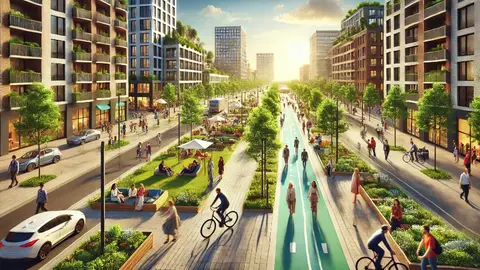
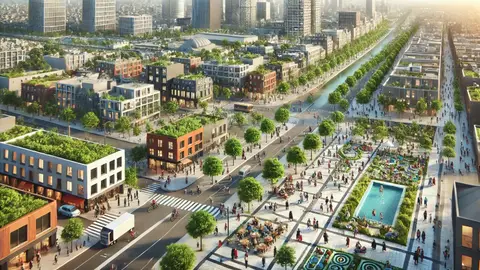
Barcelona's superblocks are the structural version: grouping nine blocks of the Eixample, pushing through traffic to the perimeter and turning the inner streets into space for staying, with limited speed, play and vegetation. The first, in Poblenou in 2016, began with paint and benches, that is, with tactical urbanism, and those of Sant Antoni and the green axes have been built with proper works. Studies by Barcelona's Public Health Agency estimate that the full plan would prevent hundreds of premature deaths a year from pollution, noise and heat.
Placemaking, promoted by Project for Public Spaces, the organisation born from Whyte's work, is the participatory method: asking those who use a place what it lacks and adding it little by little, with the rule that a good place has ten things to do. Its critics warn that placemaking without politics can become decoration, and that an improved public space raises prices around it: New York's High Line, opened in 2009, is the example of a splendid park that accelerated the gentrification of its surroundings.
Cases: Copenhagen, New York, Medellín, Madrid Río and Seoul
Copenhagen pedestrianised Strøget in 1962 amid protests from traders who predicted their ruin; today it is the centre of a network of streets and squares for people that Gehl measured for forty years, and that measurement, repeated every decade, is what allowed the city to go further each time. New York closed Times Square and Herald Square in 2009, built more than seventy plazas on surplus roadway with the NYC Plaza programme and learned that a trial with paint beats opposition better than any drawing.
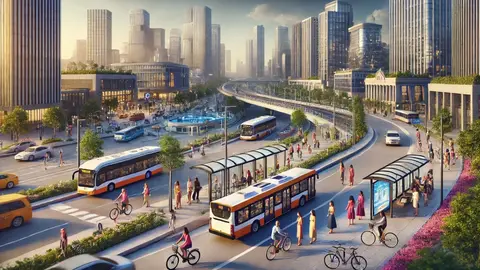
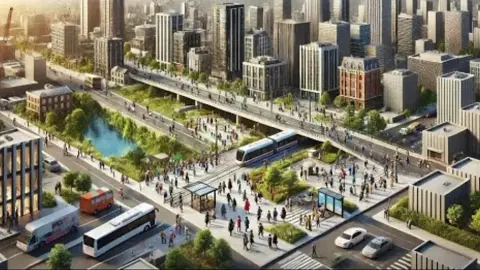
Medellín made public space the central tool of its social urbanism: the library parks on the poorest hillsides, the Metrocable that reached in 2004 neighbourhoods the state had never climbed to, and the escalators of Comuna 13 in 2011 gave back to the city places the conflict had closed. Madrid buried in 2011 the M-30 motorway along the Manzanares and built Madrid Río on top, ten kilometres of park that joined neighbourhoods separated for forty years. Seoul demolished in 2003 the elevated Cheonggyecheon expressway and recovered the river that ran beneath.
Bogotá has kept since 1974 the Sunday Ciclovía, which closes more than a hundred kilometres of streets to cars and brings more than a million people out every Sunday; it is the most copied public space policy in Latin America. And Pontevedra, in Galicia, showed that a small city can give its whole centre back to pedestrians. In every case the sequence was the same: a political decision, a visible trial, resistance, and then the evidence that people come back.
Frequently asked questions
- What is public space?
- The ground of the city freely accessible to all, streets, squares, parks and promenades, and by extension any place where one can be without paying or asking permission. Three conditions define it: access for all, unprogrammed uses and the possibility of seeing and being seen by strangers.
- What makes a plaza work?
- According to William Whyte and Jan Gehl: places to sit, sun in winter and shade in summer, trees, water, food nearby, lively edges in contact with the street and, above all, other people. Spaces fill up when they invite people to stay and not just to pass through.
- What is hostile design?
- Furniture and devices that prevent unwanted uses without forbidding them: benches with armrests so nobody can lie down, spikes, bollards under bridges or sprinklers. They expel homeless people and teenagers and turn public space into a place of passage instead of staying.
- What is tactical urbanism?
- The quick, cheap and reversible transformation of public space with paint, planters and benches to test before building. Times Square was closed to traffic that way in 2009 and Barcelona's first superblock, in Poblenou in 2016, began the same way.
- Why is public space not the same for everyone?
- Because it has been designed from the experience of an adult man with a car and no care duties. Women, children, the elderly and people with disabilities need lighting, benches, shade, obstacle-free pavements and safe streets, and the measure of a good space is that the person who has it hardest can use it.