Key points
- Autor: technology replaces routine tasks and hollows out the middle of the labour market, most of all in metropolises.
- Srnicek: platforms do not eliminate work; they fragment, precarise and surveil it with algorithms.
- Skilled centres and logistics peripheries: automation reproduces and deepens urban segregation.
Automation and urban inequality are linked because cities are at once where the jobs most exposed to artificial intelligence and robots concentrate, and where the few jobs that technology makes more valuable are created. Two authors have explained that relationship from different angles: the economist David Autor, of the Massachusetts Institute of Technology, who has spent two decades measuring how technology polarises the labour market, and the theorist Nick Srnicek, of King's College London, who in Platform Capitalism (2016) analysed how digital platforms have become the dominant way of organising the urban economy. Together they allow us to understand what kind of city automation produces if it is not governed.
David Autor: labour polarisation and the hollowing of the urban middle class
Autor documented the polarisation. Since the 1980s, technology has replaced routine tasks, those that follow explicit rules, in offices and factories, while increasing demand for highly skilled work, which complements it, and for non-routine manual work, cleaning, care, delivery, catering, which it cannot automate. The result is a labour market with two growing extremes and a hollowing middle. In his work on cities he showed that this hollowing has been most intense in metropolises: the middle-class jobs that once made cities a ladder of mobility have disappeared, and those without a university degree find worse relative wages there than forty years ago.
Nick Srnicek: platforms, data and fragmented work
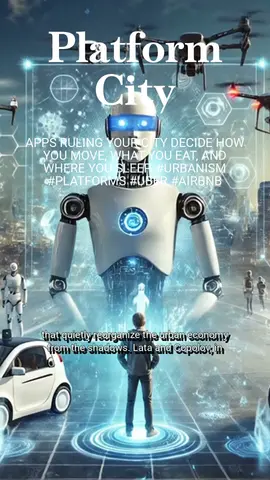
Srnicek adds the layer of platforms. Uber, Amazon, Deliveroo, Airbnb or Google are not just technology companies but a new business model based on extracting and exploiting data, intermediating between users and outsourcing risk to self-employed workers. In the city, platforms reorganise transport, delivery, accommodation and retail without owning cars, warehouses or hotels, and turn thousands of workers into rightless providers competing for jobs managed by algorithms. Srnicek shows that automation does not always eliminate work: it often fragments, precarises and surveils it.
The geography of automation: skilled centres and logistics peripheries
The geography of those processes is unequal within the city. Centres and innovation districts concentrate the skilled jobs that automation complements, with high wages and expensive housing; peripheries host the logistics warehouses, data centres and platform workers who sustain the consumption of the former with low wages and long commutes. Autor and Srnicek agree that this geography reproduces existing segregation and deepens it, because technology rewards those who already had education and capital and punishes those who only had a routine job.
Responses: training and regulation versus basic income and public platforms
The responses the two discuss differ in ambition. Autor proposes training policies, minimum wages, collective bargaining and taxation that does not subsidise replacing workers with machines, and trusts that technology will create new jobs if policy shares its gains. Srnicek, in Inventing the Future (2015) with Alex Williams, goes further: full automation, shorter working hours, basic income and public ownership of platforms, so that productivity frees time instead of producing precarity. Between the two, cities have begun to regulate: labour rights for couriers, limits on short-term rentals, mobility data as a public good.
The lesson for urban policy is that automation does not decide on its own what kind of city it produces. It can concentrate wealth in skilled districts and precarise the rest, or fund services, training and free time for all. Autor and Srnicek show that the difference lies in who owns the technology and the data, in what rights those who work through it have and in whether the city treats platforms as infrastructure to be governed or as companies to be attracted.
Frequently asked questions
What is job polarisation according to David Autor?
It is the process by which technology replaces routine office and factory tasks while demand grows for highly skilled work and non-routine manual work, so that the two extremes of the labour market grow and the middle-class centre hollows out, especially in cities.
What is Nick Srnicek's platform capitalism?
It is the business model of companies such as Uber, Amazon or Airbnb, based on extracting and exploiting data, intermediating between users and outsourcing risk to self-employed workers, which reorganises urban transport, delivery, accommodation and retail without owning the assets.