Key points
- Srnicek: platforms extract data, externalise costs and tend toward monopoly.
- Uber and Lyft increased congestion and Airbnb accelerates gentrification, according to studies in New York and San Francisco.
- Barns: platforms aspire to govern the city; the answer is data sovereignty and regulation by design.
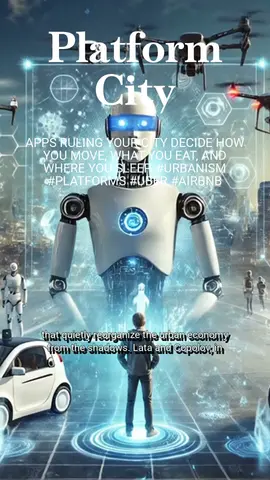
Platform urbanism is the transformation of the city by digital companies such as Uber, Airbnb, Deliveroo or Lime that, without owning taxis, hotels, restaurants or bicycles, intermediate between supply and demand, capture data and reorganise urban transport, housing, retail and work. The term was consolidated by the Australian researcher Sarah Barns in Platform Urbanism (2020), and its economic basis was explained by Nick Srnicek in Platform Capitalism (2017): platforms are a new business model whose main asset is data and whose tendency is monopoly, because the more users they have, the more valuable they become.
Nick Srnicek: data as raw material and the tendency to monopoly
Srnicek places the phenomenon in the history of capitalism. After the crisis of industrial profitability in the 1970s and the dotcom bubble, firms found in data a new raw material, and platforms are the organisational form designed to extract it: Uber records every trip, Airbnb every booking, Deliveroo every order, and that knowledge lets them set prices, steer supply and expand into new markets. Their model depends on externalising costs, the driver's car, the host's flat, the courier's bicycle, and on operating in legal grey zones until regulation arrives, if it arrives.
Mobility, housing and retail: the measurable effects
The urban effects are measurable. In mobility, studies in New York and San Francisco showed that Uber and Lyft increased congestion and drew passengers from public transport rather than replacing the private car. In housing, David Wachsmuth and Alexander Weisler demonstrated in 2018 that Airbnb opens a rent gap that draws investors into city centres and accelerates gentrification, with commercial hosts running multiple listings capturing most of the revenue. In retail, the ghost kitchens and dark stores of delivery platforms replace shops open to the public with closed warehouses on ground floors.
Platform work: algorithms, the rider law and the EU directive
Work is the other face. Platform drivers, couriers and cleaners are formally self-employed and in practice directed by an algorithm that assigns tasks, sets rates and sanctions, without minimum wage, holidays or accident cover. Cities have been the stage of that dispute: Spain's rider law of 2021 presumed couriers to be employees, and the European directive on platform work of 2024 extended that presumption; Uber and Deliveroo have responded by leaving markets or changing models. The platform city produces jobs and precarity at once.
Sarah Barns: governing the city through platforms
Barns adds the dimension of government. Platforms not only operate in the city but aspire to govern it: their data are better than the municipality's, their apps are the everyday interface with transport and consumption, and their agreements with city halls, from mobility data to scooter licences, give private firms a power over public space that once belonged to planning alone. The response she proposes is data sovereignty and regulation by design: requiring open data, conditional licences and operating limits as the price of access to the urban market.
The lesson of platform urbanism is that the digital city is not neutral. Every app redistributes space, rent and power, and a city that does not regulate ends up governed by the terms of service of companies that do not answer to its residents. The cities that have acted, from Barcelona on tourist rentals to New York on for-hire vehicles, show that regulation is possible when data and will exist. The question Srnicek and Barns leave is who keeps the value the city produces when a platform intermediates it.
Frequently asked questions
What is platform urbanism?
It is the transformation of the city by digital companies that, without owning taxis, hotels or bicycles, intermediate between supply and demand, capture data and reorganise urban transport, housing, retail and work, a term consolidated by Sarah Barns in Platform Urbanism (2020).
How can cities regulate platforms?
By requiring open data, conditional licences and operating limits as the price of access to the urban market, as Barcelona has done with tourist rentals and New York with for-hire vehicles, and by applying the employment presumption of Spain's rider law and the 2024 EU directive.