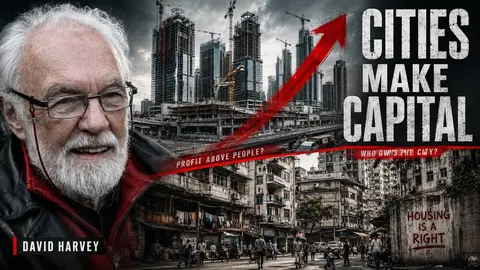
David Harvey
1935
British geographer who explained the city as a product of capital: where it invests, who stays and who is pushed out.
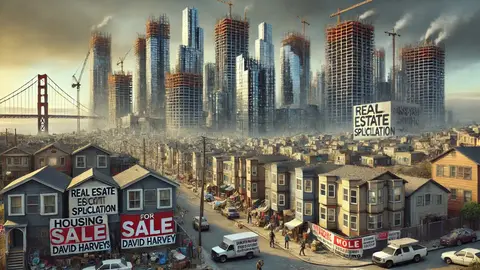
Harvey trained a whole generation of urbanists by showing that geography is not a stage on which the economy happens, but one of its instruments. When capital runs out of room to grow, it moves into land and buildings: that is what he called the «spatial fix», and it explains the cycles of construction, bubble and crisis that repeat across very different cities.
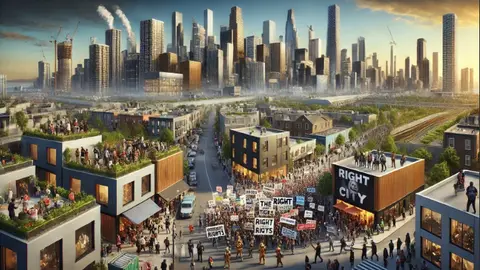
From there comes his most cited concept, «accumulation by dispossession»: urban growth that advances by taking away — affordable housing, public land, entire neighbourhoods. Picking up Lefebvre's right to the city, Harvey turned it into a concrete demand: being able to live in the city is not enough, you have to be able to decide what it becomes.
On David Harvey in this archive
- Urban economy
Capitalist Accumulation in Urban Spaces
This article explains how capitalist accumulation transforms urban spaces through investment, infrastructure, and…
David Harvey 3 min read - Housing
The historic center, a deceptive facade
Walk through the historic centre of a big city and everything looks perfect. Restored facades, clean streets, full…
Henri Lefebvre 4 min read - Urban geopolitics
The city is written by speculative funds, not planners
There is a map of your city that nobody debated in a council session. No councillor and no urban planner signed…
David Harvey 4 min read - Urban economy
Rebel Cities: Urban Struggles for Social Justice
This article explores how cities are battlegrounds for social justice, driven by urban capitalism. It discusses the…
Henri Lefebvre 2 min read - Urban economy
Critical Urbanism: Understanding Urban Inequities
Critical urbanism is a school of thought that fundamentally questions the power dynamics and social inequalities…
David Harvey 3 min read - Urban economy
David Harvey: the right to the city under neoliberalism
David Harvey explains how neoliberalism turned housing into a commodity, and why the right to the city means…
Henri Lefebvre 3 min read - Mobility
Right to Mobility and Social Justice in Cities
The right to mobility ensures equitable access to transportation and movement in cities, impacting social justice…
David Harvey 2 min read - Urban history
Paris and Capitalist Modernization
This article explores how Paris's modernization under Haussmann reflected capitalist urban development and social…
David Harvey 2 min read - Shrinking cities
Postindustrial Cities Economic Shifts
Postindustrial cities face economic restructuring, reshaping urban landscapes and social dynamics. Global…
John Friedmann 2 min read - Public space
Urban Social Movements: Struggles for Justice and Equity
Urban social movements have emerged as key responses to the economic and social transformations shaping…
Manuel Castells 1 min read - Housing
Real Estate Speculation: Growth or Crisis in Cities?
Real estate speculation and the financialization of housing have profoundly transformed urban housing markets
David Harvey 2 min read - Public space
The Right to the City: A Struggle for Inclusion and Urban Justice
The concept of the “right to the city” was first proposed by Henri Lefebvre in 1968 and has since become a…
Henri Lefebvre 2 min read