Erik Swyngedouw
1956
Belgian geographer who founded urban political ecology: the water, air and greenery of the city are produced and distributed with power.
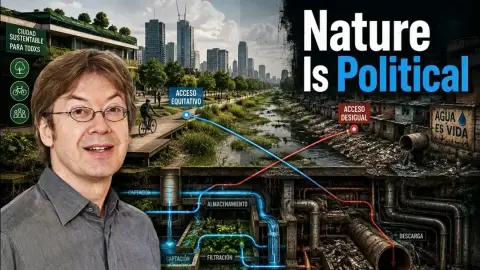
Born in Belgium in 1956, trained in Leuven and at Johns Hopkins with David Harvey, and professor of geography at the University of Manchester after two decades at Oxford, Swyngedouw is the founder, with Maria Kaika and Nik Heynen, of urban political ecology. His starting point is that nature in the city does not exist apart from society: the water from the tap, the air one breathes and the neighbourhood park are products of decisions, investments and conflicts, and are therefore unequally distributed.
Social Power and the Urbanization of Water (2004) followed the water of Guayaquil from the watersheds to the neighbourhoods without a network to show that scarcity is manufactured, and Liquid Power (2015) did the same for twentieth-century Spain, where dams, transfers and irrigation built a territory and a state at once. His concept of urban metabolism, taken from Marx, describes the city as a continuous flow of matter, energy and capital.
His other line is the critique of the post-political: in Promises of the Political (2018) and in his articles on sustainability and resilience he argues that the technocratic consensus on climate hides the conflict over who pays and who decides, and that the just city requires re-politicising what is presented as management. He is one of the most cited European geographers and his framework is used today to study droughts, floods and river restorations.
Videos on Erik Swyngedouw (1)
- Urban ecology
Liquid Power by Erik Swyngedouw: Water, Power and Modernisation
Liquid Power (2015) by Erik Swyngedouw explains how dams, transfers and irrigation were the instrument of power…
Erik Swyngedouw 3 min read

Where Erik Swyngedouw is cited (8)
- Urban ecology
Matthew Gandy: Urban Nature Reveals Power in the City
Matthew Gandy shows that water, waste, parks and expressways are nature produced by political decisions: urban…
Matthew Gandy 3 min read - Urban ecology
Karen Bakker: Why Water Privatisation Failed in Cities
Karen Bakker showed that water is an uncooperative commodity and that neither privatisation nor bureaucracy solves…
Karen Bakker 3 min read - Urban history
A City on a Lake by Matthew Vitz: Mexico City and Its Lake
A City on a Lake by Matthew Vitz explains how Mexico City grew on the drained Lake Texcoco and how water, forests…
Matthew Vitz 3 min read - Urban ecology
City of Flows by Maria Kaika: The City and Its Invisible Flows
City of Flows (2005) by Maria Kaika shows how the modern city domesticated nature and hid its flows of water and…
Maria Kaika 3 min read - Urban ecology
Right to Water and Environmental Justice: Swyngedouw and Davis
The right to water, recognised by the UN in 2010, is contested in the city. What Erik Swyngedouw and Mike Davis…
3 min read - Urban ecology
Urban Political Ecology: Swyngedouw, Kaika and Heynen
Urban political ecology studies who gets water, air and greenery in the city: water as commodity in Swyngedouw,…
2 min read - Urban ecology
Urban River Restoration: What It Is and Examples
Urban river restoration reopens channelised rivers to cut flood risk and heat. What Erik Swyngedouw and Maria Kaika…
2 min read - Urban ecology
Water and Power: Urban Water per Swyngedouw, Kaika and Bakker
Water management in cities decides who gets water, at what price and who suffers droughts and floods. What Erik…
3 min read