Neil Brenner
1969
American sociologist who argues there is no longer an outside to the urban: urbanisation also organises the countryside, the mine and the ocean.
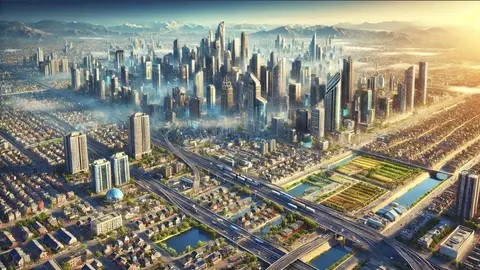
Brenner disputes the very idea of the «city» as a bounded object. His thesis of planetary urbanisation holds that the urban is not a place but a process: a soy plantation, a logistics hub or an undersea cable are as urbanised as a historic centre, because they exist to sustain it.
One practical consequence follows: if a city's sustainability is measured only within its municipal boundary, the territory that feeds it, supplies its energy and absorbs its waste is ignored. Honest accounting includes what happens far away.
An American sociologist and urban theorist, Brenner taught at New York University and at the Harvard Graduate School of Design, where he founded the Urban Theory Lab, and since 2020 he is a professor at the University of Chicago. New State Spaces (2004) showed how European states reorganised their territory from the 1970s, shifting from equalising regions to promoting competitive cities, and with Nik Theodore and Jamie Peck he formulated the idea of actually existing neoliberalism, which is not a state but a process of destruction and creation different in each city.
His most debated thesis is planetary urbanization, developed with Christian Schmid from Lefebvre and gathered in Implosions/Explosions (2014) and New Urban Spaces (2019): urbanisation is no longer limited to cities but reorganises mines, oceans, fields and forests, and the age of cities is a misleading statistic. He co-edited Cities for People, Not for Profit (2012) and in 2011 criticised assemblage urbanism for flattening power. Feminist and postcolonial scholars reproach him for an overly abstract theory; his influence on critical urban theory is hard to overstate.
Videos on Neil Brenner (3)
- Urban geopolitics
Neil Brenner: Global Urbanization Goes Beyond City Borders
Neil Brenner argues that urbanization does not fit administrative boundaries: scale, state restructuring, extended…
Neil Brenner 3 min read - Urban geopolitics
Neil Brenner's New State Spaces: Globalisation and Urban Governance
Neil Brenner's New State Spaces explains how globalisation reorganised states in space: from spatial Keynesianism…
Neil Brenner 2 min read - Urban geopolitics
Planetary Urbanization: Neil Brenner and Christian Schmid's Thesis
Planetary urbanization holds that the urban has no outside: mines, plantations and networks are part of the city.
Neil Brenner 2 min read


Where Neil Brenner is cited (12)
- Public space
Innovation or Disguised Austerity in Tactical Urbanism?
Tactical urbanism was born as a rehearsal for the permanent and often ends as cuts with colours: Lydon and Garcia,…
3 min read - Urban geopolitics
Bob Jessop: The State and Neoliberal Urban Restructuring
Bob Jessop explains how the state moved from Keynesian welfare to competitive workfare and what it means for…
Bob Jessop 3 min read - Urban economy
Nik Theodore: Neoliberal Urbanism, Informal Work and Migrants
Nik Theodore explains how neoliberal urbanism produces precarity, what his studies of day labourers and migrants in…
Nik Theodore 2 min read - Urban economy
Peter Marcuse: Social Justice and Urbanism Against Neoliberalism
Peter Marcuse explained how neoliberalism put planning at the service of capital and what a just city requires.…
Peter Marcuse 2 min read - Urban economy
Jamie Peck: Constructions of Neoliberal Reason and the City
Jamie Peck's Constructions of Neoliberal Reason explains neoliberalism as a process that finds its laboratory in…
Jamie Peck 2 min read - Urban economy
Critical Urbanism: What It Is and What Harvey and Brenner Propose
Critical urbanism analyses the city as a product of power and capital. What David Harvey and Neil Brenner…
2 min read - Urban geopolitics
Henri Lefebvre: The Urban Revolution as a Global Process
In The Urban Revolution (1970) Henri Lefebvre argues that urbanisation overflows the city and becomes a global…
Henri Lefebvre 2 min read - Public space
Interstitial Spaces: Resistance and Creativity in the City's Gaps
Interstitial spaces, vacant lots, warehouses and motorway undersides, are where the city reinvents itself.
3 min read - Public space
Margit Mayer and the Struggle for the Right to the City
Margit Mayer explains how urban movements win the right to the city and how neoliberalism co-opts them with mottos…
Margit Mayer 3 min read - Urban geopolitics
Jennifer Robinson and Ordinary Cities: Urban Theory from the South
Ordinary Cities (2006) by Jennifer Robinson holds that all cities are ordinary and sources of theory. Her critique…
Jennifer Robinson 3 min read - Public space
Citizen Participation in Urban Governance: Keys and Limits
Citizen participation decides who shapes the city. What Neil Brenner and Saskia Sassen explain, which mechanisms…
2 min read - Urban form
Postmodern Urban Planning: Assemblage, Participation and Critique
What postmodern urban planning is: Sandercock and insurgent planning, Healey, the assemblage theory of Farías and…
2 min read