Key points
- De Certeau separates the strategies of the powerful from the tactics of the weak; interstices are where tactics last.
- Mayer shows in Berlin how gardens, squats and Tempelhof become urban politics.
- The creativity that animates a lot attracts capital: without community ownership, resistance ends in lofts.
Interstitial spaces are the places that urban planning leaves without a defined use: vacant lots, abandoned warehouses, the undersides of motorways, railway margins, rooftops, party walls, forgotten stretches of river. The architect Ignasi de Solà-Morales called them terrain vague in 1995, land at once empty and available, and since then urban theory has studied them as the productive reverse of the planned city: where control loosens, gardens, workshops, parties, occupations and art appear. Two authors explain why: Michel de Certeau, who theorised the tactics of everyday life, and Margit Mayer, who studied how urban movements turn those gaps into politics.
Michel de Certeau: tactics of the weak in the city
De Certeau, in The Practice of Everyday Life (1980), distinguishes strategies from tactics. Strategies belong to those who have a place of their own and the power to order it: the state, the corporation, the planner who zones and surveils. Tactics are the art of the weak: uses of someone else's time and space that seize the occasion without being able to hold it. Walking in the city, De Certeau says, is already a tactic: every pedestrian invents shortcuts, stops where it was not planned and writes with their steps a text the map does not record. Interstitial spaces are where those tactics become visible and durable, because nobody has planned them or fully controls them.
Margit Mayer and the movements that occupy the gaps
Mayer, a political scientist at the Free University of Berlin and co-editor of Cities for People, Not for Profit (2012) with Neil Brenner and Peter Marcuse, has followed for four decades the urban movements that occupy those gaps. In Berlin, the squatted houses of Kreuzberg in the 1980s, the Prinzessinnengärten community gardens on a vacant lot at Moritzplatz since 2009 or the former Tempelhof airport, turned into a park by citizen pressure and defended in a 2014 referendum against development, show how interstices become places of meeting, organisation and political dispute. Mayer stresses that these movements have moved from squatting for housing to defending public space and the right to the city.
Art, creativity and the risk of gentrification
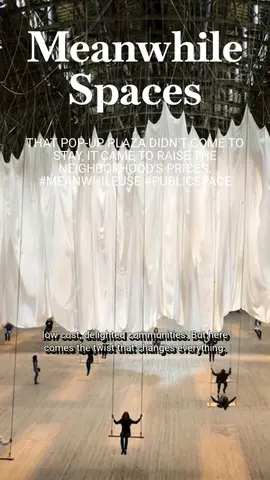
Artistic use is the other face of these places. Graffiti, ephemeral installations, open-air cinemas in empty warehouses and creators' studios in abandoned factories have made interstices the cultural incubator of European and American cities. That use, however, has a well-known effect: the creativity that brings a marginal place to life makes it desirable, and desirability attracts real estate capital. The cycle Sharon Zukin described for SoHo repeats on every reclaimed lot, and what was resistance ends up as the selling point for a loft development.
Tactical urbanism, temporary uses and who keeps the value
Here lies the central tension both authors point to. City governments have learned to use interstices as a tool: tactical urbanism and temporary uses legalise gardens, markets and cultural activities on lots awaiting development, which improves the neighbourhood at low cost but also prepares it for rising values. What was born as the tactic of the weak becomes the strategy of the strong. Mayer warns that without legal protection, long-term leases or community ownership, movements end up working for free for those who later displace them.
The politics of interstitial space therefore consists in deciding who keeps the value those places create. Keeping them open requires instruments that take them out of the market, land trusts, indefinite public leases, protection as community facilities, and recognising the people who animate them as legitimate producers of the city. De Certeau teaches us to see the gaps as places where the city reinvents itself every day; Mayer, to defend them as commons. Between those two readings is decided whether interstices remain the city's laboratory or merely its next plot.
Frequently asked questions
What are interstitial spaces in the city?
They are the places left without a defined use by planning, such as vacant lots, abandoned warehouses, motorway undersides or railway margins, called terrain vague by Solà-Morales, where gardens, workshops, occupations and art appear outside planning control.
What is the difference between strategy and tactic according to De Certeau?
Strategy belongs to those with a place of their own and the power to order it, such as the state or the planner; tactic is the art of the weak, using someone else's space by seizing the occasion without being able to hold it, like the pedestrian inventing shortcuts.