Neil Smith
1954–2012
Scottish-American geographer who explained gentrification with an equation: the gap between what land earns and what it could earn.
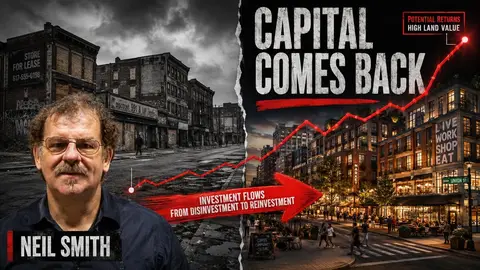
Against those who explained gentrification by the tastes of a new middle class, Smith pointed at the money. His «rent gap» measures the distance between what run-down land yields and what it would yield reinvested. When that gap is wide enough, investment arrives — and it arrives for the whole neighbourhood, not one house.
He also described the «revanchist city»: urban policy that treats poverty as a public-order problem and answers with evictions, by-laws and surveillance. Smith wrote it about 1990s New York, but the description is recognisable in many cities thirty years on.
A Scottish geographer born in Leith in 1954, a student of David Harvey at Johns Hopkins University and a professor at Rutgers and at the Graduate Center of the City University of New York until his death in 2012, Smith formulated in 1979, at twenty-five, the rent gap theory: gentrification happens when the difference between what land yields and what it could yield makes reinvestment in the disinvested neighbourhood profitable. It was the first explanation of gentrification from the supply of capital and not from consumers' taste.
Uneven Development (1984) generalised the idea to every scale, and The New Urban Frontier (1996) read 1990s New York as a revanchist city reconquering central neighbourhoods by expelling the poor and the homeless, with Tompkins Square Park as its case. In 2002 he argued that gentrification had become a global urban strategy. He was also a historian of geography, with American Empire (2003) on Isaiah Bowman, and his work remains the starting point of critical research on gentrification.
Videos on Neil Smith (1)
- Housing
Neil Smith and Gentrification: Rent Gap and the Revanchist City
Neil Smith explained why gentrification happens: the rent gap that draws capital and the revanchist city that…
Neil Smith 2 min read

Where Neil Smith is cited (12)
- Housing
The Rent Gap: How It Reveals When Gentrification Has Already Begun
Neil Smith's rent gap measures the difference between current and potential land rent and shows that gentrification…
3 min read - Housing
Art Washing: Murals, Investment and Displacement in Cities
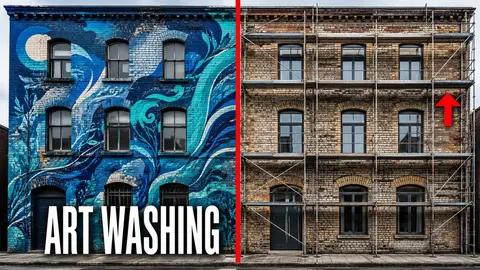
Art washing uses murals, galleries and festivals to prepare working-class neighbourhoods for investment.
3 min read - Urban geopolitics
Urban Geography in the 21st Century: Challenges and New Frontiers
How urban geography has changed: theory beyond the Global North, cities and climate change, technologies of…
2 min read - Housing
Loïc Wacquant: why the ghetto is not an accident
Wacquant compares American ghettos with French banlieues and shows that advanced marginality is not residual but…
2 min read - Shrinking cities
Deindustrialization and Urban Reuse: Lofts, Rent Gap and Culture
Reusing industrial land turns factories and docks into housing, culture and parks. What Sharon Zukin and Neil Smith…
2 min read - Housing
Anna Minton: Ground Control and the Privatisation of Public Space
Anna Minton exposed in Ground Control and Big Capital the privatisation of public space, security by design and…
Anna Minton 3 min read - Shrinking cities
Post-Industrial Regeneration: Guggenheim Effect, Culture and Exclusion
Post-industrial regeneration bet on culture and tourism after the factories, from Bilbao to Glasgow.
3 min read - Housing
Gentrification and Displacement: Smith, Lees and Slater
Gentrification raises neighbourhood values and displacement pushes residents out. What Neil Smith, Loretta Lees and…
3 min read - Urban form
Reurbanization and Urban Renewal: Opportunities, Risks and Cases
Reurbanization reuses central land but can expel residents. What Sharon Zukin, Neil Smith and Michael Storper…
3 min read - Housing
Ruth Glass and Gentrification: London, Aspects of Change
Ruth Glass coined gentrification in 1964 to describe middle-class newcomers displacing Islington's working class.…
Ruth Glass 2 min read - Shrinking cities
Reusing Abandoned Spaces: Opportunities and Risks
Reusing abandoned factories, stations and lots preserves heritage and central land, but it can gentrify.
3 min read - Urban economy
How Capitalism Shapes Cities: David M. Gordon and Harvey
How capitalism shapes cities according to urban political economy: David M. Gordon's three phases, Harvey's…
2 min read