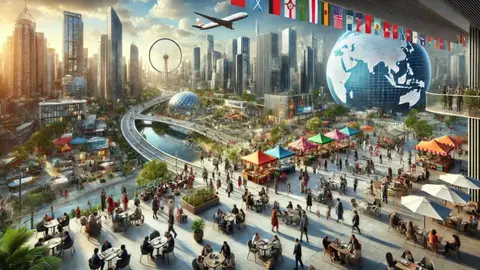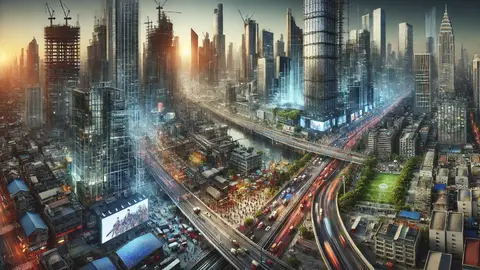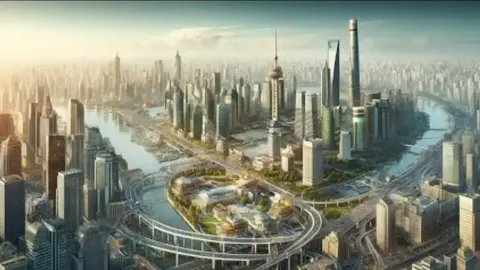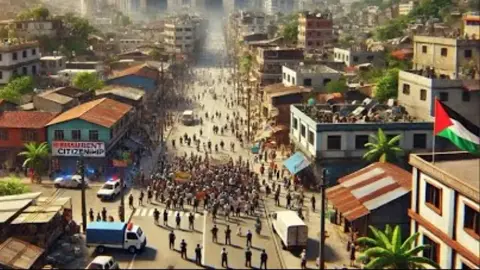
A global city is not simply a large or famous one. It is a precise concept Saskia Sassen formulated in 1991 to name a new phenomenon: the more geographically dispersed production becomes, the more the command functions — accounting, commercial law, advertising and finance — needed to govern it concentrate in a handful of points.
This guide explains the theory and its mechanism, reviews the criticisms it has received, presents what Global South urban studies propose, and examines the other side of the matter: the infrastructure, ports, corridors and cables through which all of it circulates, and the geopolitics that orders them.
Sassen's thesis: concentration through dispersal
The starting point of The Global City (1991) is counterintuitive. When a firm manufactures in six countries, sells in eighty and subcontracts in twenty, it needs an enormous quantity of specialised services to coordinate all that: lawyers who understand three jurisdictions at once, auditors, insurers, risk analysts. Those services are bought in and produced in very few places.
Sassen studied New York, London and Tokyo and found that the three worked as a system rather than as competitors, with chained time zones and flows between them greater than with their own countries. The global city is not where the companies are headquartered, but where the services those companies need and cannot produce in house are located.
Her second thesis is the most quoted and least understood: this economy produces polarisation. Advanced services pay a few people very well and generate around them a massive demand for very low-paid work — cleaning, security, delivery, care, hospitality — that physically sustains the operation. The global city is not rich: it is unequal, and both come from the same mechanism.
Rankings and what they hide
The concept became popular and turned into an index. The GaWC research network at Loughborough University has classified the world's cities since 1999 by their degree of connection, measuring the presence of large advanced service firms, and various commercial indices have made their own versions.
The problem is circularity. If you measure globality by counting the offices of international consultancies and law firms, cities with many such offices come out global by definition, and those connected to the world by other routes — migration, remittances, informal trade, diaspora, cultural production — do not appear. On that criterion, a city sending millions of workers abroad and receiving billions in remittances can register as peripheral.
The political use of rankings adds another distortion. Councils began setting themselves the goal of climbing places, which steers investment towards airports, business districts, convention centres and mega events, spending justified by its effect on position rather than on residents. This is the entrepreneurial urbanism David Harvey criticised.
The critique: theory built from five cases
Jennifer Robinson made the most influential objection in Ordinary Cities (2006). She pointed out that urban theory is built from a handful of Western cities and then applied to the rest as though they were incomplete versions of that model. On that view, Lagos, Jakarta and Lima are not cities with their own logic but cities that have not yet become London.
Her proposal is to treat all cities as ordinary, that is, as cases from which to build theory on equal terms. The point is not that Lagos is exceptional, but that there is no reason for general urban theory to be made only out of New York.
Ananya Roy took the argument further by criticising how informality is treated. She showed that informality is not the absence of the state or marginal disorder but a mode of government: the state decides which occupations it tolerates, which it legalises and which it demolishes, and that discretion is an instrument of power. She also observed that elites practise informal urbanism too, with developments that breach the rules and are regularised afterwards.
What Southern urban studies propose
AbdouMaliq Simone coined in Johannesburg the formula that best sums up this shift: people as infrastructure. Where there is no reliable network for transport, water or credit, what performs that function are relations between people, arrangements, intermediaries and networks of trust that let the city work every day. This is not folklore: it is the real infrastructure, and studying it demands different methods.
Garth Myers has argued in African Cities (2011) that applying Western categories unchanged to African cities mainly produces a list of deficiencies, and proposes starting from how they are actually organised. Mike Davis gave the pessimistic and widely read version in Planet of Slums (2006), with forceful data on the growth of informal settlement, though he has been criticised for leaving little room for the agency of those who live there.
The other, more constructive line comes from practice: the international federation Slum Dwellers International has developed censuses and mapping carried out by settlement residents themselves, a method that has proved more reliable than official statistics and has been used to negotiate with municipalities from a position of strength.
The infrastructure holding it all up
Behind the financial flows are very physical objects: ports, container terminals, rail corridors, cargo airports, data centres and submarine cables. Deborah Cowen showed in The Deadly Life of Logistics (2014) that this network is governed by a logic inherited from the military, in which keeping the flow moving is the objective and any interruption, including a strike or a protest, is treated as a security problem.
Jean-Paul Rodrigue has described how major ports have extended inland through dry terminals connected by rail, reorganising the industrial geography of entire regions. And special economic zones, with their own labour and tax regimes, are the characteristic territorial form of this system: enclaves where rules differ from those of the country hosting them.
The geopolitics of the last decade has made visible what looked technical. China's Belt and Road, ports financed in Africa and southern Europe, the dispute over semiconductors and the siting of data centres have turned logistical and digital infrastructure into a matter of foreign policy. A port city today negotiates with powers, not only with shipping lines.
Urban colonialism: what was left built
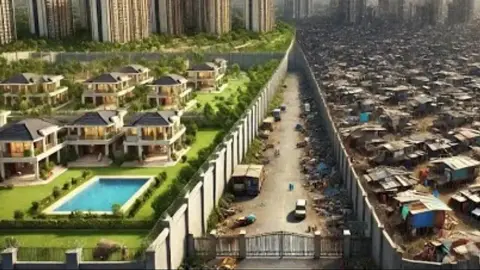
Many Southern cities retain the physical structure colonial administration gave them, not as picturesque residue but as a working arrangement. The separation between the European city, with its regular grid, services and large plots, and the dense, unserviced indigenous quarters can still be read in the land registry, the sewer network and land prices in Nairobi, Algiers, Kolkata and Jakarta.
Brenda Yeoh documented in Contesting Space in Colonial Singapore (1996) how that arrangement was imposed and how it was resisted, street by street. And the effect is not limited to built form: inherited planning codes, with their minimum plot sizes and imported standards, still declare illegal the way of building most of the population can afford, producing informality by regulatory definition.
Understanding this changes the diagnosis. When seventy per cent of a city is informal, the problem is not that people break the rules but that the rules describe a city that never existed. The policies that have worked, from tenure recognition to progressive upgrading, begin by accepting what is built and improving it rather than replacing it.
How to use all this to look at a city
There are four useful questions. What does this city connect to the world with: finance, manufacturing, migration and remittances, tourism, raw materials, culture? The answer completely changes who wins and who loses in it. What share of its employment depends on that connection, and under what conditions do those people work?
What infrastructure sustains it and who owns it? A port concessioned to a global operator, an airport in the hands of a fund or a foreign-owned data centre shape a city's future more than many master plans. And finally, who writes the theory by which that city is judged, and from where?
The value of the Southern critique is methodological rather than identitarian: if the tools were built from five atypical cases, they will describe the rest badly and, worse, propose policies designed for a situation that does not exist there. And Sassen's warning remains the most pertinent in rich cities: the inequality of a global city is not a flaw in its model, it is a direct consequence of how it works.
Frequently asked questions
- What is a global city?
- According to Saskia Sassen, one that concentrates the specialised command services — finance, commercial law, auditing, advertising — that an economy with globally dispersed production requires. It is not a synonym for a large city or a capital.
- Why are global cities unequal?
- Because the same mechanism generating very well-paid jobs in advanced services generates around them a massive demand for low-paid work — cleaning, security, delivery, care — that physically sustains that economy.
- What is the ordinary cities critique?
- Jennifer Robinson's objection to urban theory being built from a handful of Western cities and applied to the rest as though they were incomplete versions. She proposes treating all cities as valid cases from which to build theory.
- What is urban informality according to Ananya Roy?
- Not the absence of the state but a mode of government: the state decides which occupations it tolerates, which it legalises and which it demolishes. Elites practise it too, with developments that breach the rules and are regularised later.
- What does people as infrastructure mean?
- AbdouMaliq Simone's formula: where there are no reliable networks for transport, water or credit, it is relations between people, arrangements and intermediaries that perform that function and make the city work each day.