Sharon Zukin
1946
American sociologist who showed how culture — galleries, cafés, markets — becomes the economic engine that makes a neighbourhood expensive.
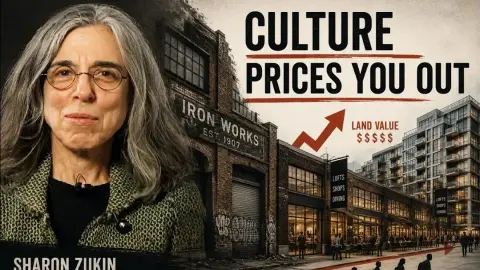
Zukin studied New York's SoHo when it was still an industrial district occupied by artists, and found the mechanism that has since repeated across half the world: first come those looking for cheap rent and space, then those looking for the atmosphere the first group created, and in the end the price pushes out both.
Her most uncomfortable contribution is the concept of «authenticity». A neighbourhood's character — the old bakery, the mural, the market — stops being a way of life and becomes a selling point. Zukin argues that is the moment the neighbourhood is lost, even if the buildings are still standing.
An American sociologist, professor emerita at Brooklyn College and the Graduate Center of the City University of New York, Zukin published in 1982 Loft Living, the study that explained how the industrial lofts of SoHo became artists' homes and then luxury products, and that anticipated everything written since on culture and gentrification. Landscapes of Power (1991) followed the shift from the industrial city to the city of consumption, and The Cultures of Cities (1995) defined the symbolic economy: culture as a resource with which cities compete.
Naked City (2010) is her most widely read book: the search for authenticity in Williamsburg, Harlem or the East Village destroys what it sought, because the cafés and shops that attract new residents push out the old ones. Point of Purchase (2004) studied consumption and The Innovation Complex (2020) New York's tech city. Her method, an urban ethnography attentive to culture and capital, has trained generations of urban sociologists.
On Sharon Zukin in this archive
- Urban history
Christine Boyer: How the City Turns Memory into a Tool of Power
M. Christine Boyer shows in The City of Collective Memory that heritage and urban images are selected and…
Battery Park City 3 min read - Housing
Sharon Zukin: How Culture Turns a Neighbourhood into a Product
Sharon Zukin explains how the symbolic economy raises a neighbourhood's value before prices rise: the sequence of…
Sharon Zukin 3 min read - Housing
Art Washing: Murals, Investment and Displacement in Cities
Art washing uses murals, galleries and festivals to prepare working-class neighbourhoods for investment.
Sharon Zukin 3 min read - Housing
The Historic Centre as a Deceptive Façade: Tourism Without Neighbours
Historic centres restore their stones and lose their residents to short-term rentals and souvenir shops.
Sharon Zukin 3 min read - Housing
Naked City by Sharon Zukin: Gentrification and Urban Authenticity
Naked City (2010) by Sharon Zukin shows how the search for authenticity gentrifies New York's neighbourhoods.
Robert Moses 2 min read - Urban economy
The Spectacle City: Consumption and Exclusion per Debord and Zukin
The spectacle city is built to be seen: events, icons and showcases that exclude residents. What Guy Debord and…
David Harvey 3 min read - Urban economy
Sharon Zukin: Cultural Capital and Urban Transformation
A city's cultural capital draws investment and tourism, but it also gentrifies. What Sharon Zukin explains in The…
Sharon Zukin 2 min read - Public space
Interstitial Spaces: Resistance and Creativity in the City's Gaps
Interstitial spaces, vacant lots, warehouses and motorway undersides, are where the city reinvents itself.
Peter Marcuse 3 min read - Shrinking cities
Deindustrialization and Urban Reuse: Lofts, Rent Gap and Culture
Reusing industrial land turns factories and docks into housing, culture and parks. What Sharon Zukin and Neil Smith…
Battery Park City 2 min read - Housing
Anna Minton: Ground Control and the Privatisation of Public Space
Anna Minton exposed in Ground Control and Big Capital the privatisation of public space, security by design and…
Sharon Zukin 3 min read - Urban history
Decolonising Urban Heritage: Statues, Streets and Memory
Decolonising urban heritage reviews which colonial monuments and names occupy public space. What Sharon Zukin and…
Sharon Zukin 3 min read - Shrinking cities
Post-Industrial Regeneration: Guggenheim Effect, Culture and Exclusion
Post-industrial regeneration bet on culture and tourism after the factories, from Bilbao to Glasgow.
Sharon Zukin 3 min read - Urban economy
Touristification: Zukin, Sassen and the city for tourists
What touristification is and how Sharon Zukin (Naked City) and Saskia Sassen explain it: authenticity turned into a…
Saskia Sassen 2 min read - Urban form
Reurbanization and Urban Renewal: Opportunities, Risks and Cases
Reurbanization reuses central land but can expel residents. What Sharon Zukin, Neil Smith and Michael Storper…
Michael Storper 3 min read - Urban economy
Ann Markusen: Creative Economy, Artists and Urban Development
Ann Markusen measured what artists contribute to the urban economy, defined creative placemaking and criticised…
Richard Florida 3 min read - Shrinking cities
Reusing Abandoned Spaces: Opportunities and Risks
Reusing abandoned factories, stations and lots preserves heritage and central land, but it can gentrify.
Sharon Zukin 3 min read - Urban economy
Creative Urbanism: From Landry and Florida to Their Critics
Creative urbanism uses culture and art to regenerate cities. What Charles Landry and Richard Florida propose, what…
Richard Florida 3 min read