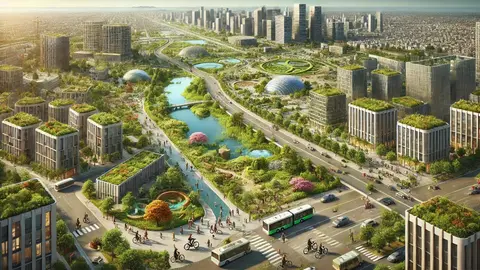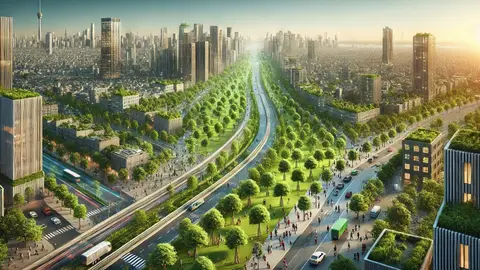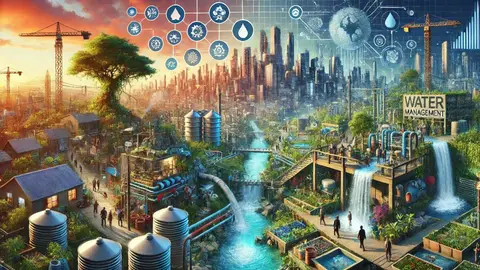
Green infrastructure is the set of natural elements in a city — trees, parks, rivers, permeable soils, green roofs — understood not as decoration but as a network delivering measurable services: it lowers temperature, absorbs rainwater, filters pollutants, supports biodiversity and improves the health of those living nearby.
This guide explains exactly which services it provides, how they are put into figures with the tools that exist, why one old tree is worth far more than ten newly planted ones, what to do with water and with waste, and how to avoid the best-documented perverse effect of urban green: that the new park displaces the residents it was meant to benefit.
Green is not decoration: which services it provides
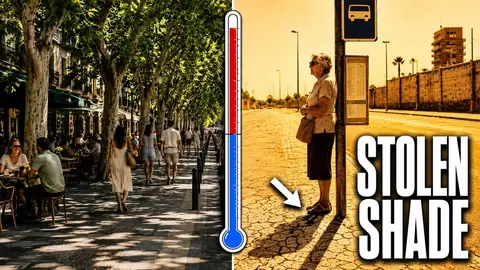
An urban tree does five things at once. It gives shade, which is what lowers perceived temperature on the pavement by several degrees. It cools the air through evapotranspiration, a mechanism no pergola reproduces. It intercepts part of the rainfall and delays its arrival in the sewer. It removes particulates and some gaseous pollutants. And it stores carbon, though in a city this is the least important of its functions.
Permeable soil provides a different and more underrated service: it infiltrates water, recharges the aquifer, supports subsurface life and lets trees actually grow. A large share of urban tree failures is not a species problem but a tree pit problem: one square metre of compacted soil between concrete will not support a large crown, however much you water it.
And there are the services that are not physical. Proximity to green space is fairly consistently associated with better mental health, more physical activity and better general health indicators, and the effect is larger among low incomes, who have fewest alternatives. That is the public health argument for urban green, and it is stronger than the climate argument.
Putting numbers on it: how to justify a pruning budget
The classic problem with street trees is accounting: the benefits are diffuse and the costs sit in a specific budget line somebody wants to cut. David Nowak, of the US Forest Service, solved this by developing the models that convert diameter, species, crown and location into tonnes of pollutant removed, kilowatts saved on heating and cooling, and cubic metres of avoided runoff.
The practical result is i-Tree, a set of free tools now used by thousands of cities to inventory their trees and calculate their annual return in money. With that figure on the table, pruning stops being an aesthetic expense and becomes maintenance of an infrastructure, exactly like the sewers.
The most useful number that calculation produces is the size asymmetry: a mature broad-crowned tree delivers several times the service of a young one, because almost everything depends on leaf area. Hence the rule Nowak repeats and almost no city applies: keeping one large tree is worth more than planting ten small ones, and replacing a mature specimen with a sapling is, for twenty or thirty years, a net loss.
Water: from evacuating it to holding it
The twentieth-century drainage model consisted of getting rainwater out of the city as fast as possible through a buried network. That model fails for two reasons: it was sized for rainfall that is no longer what falls, and it concentrates the whole flow downstream, where it causes the flood.
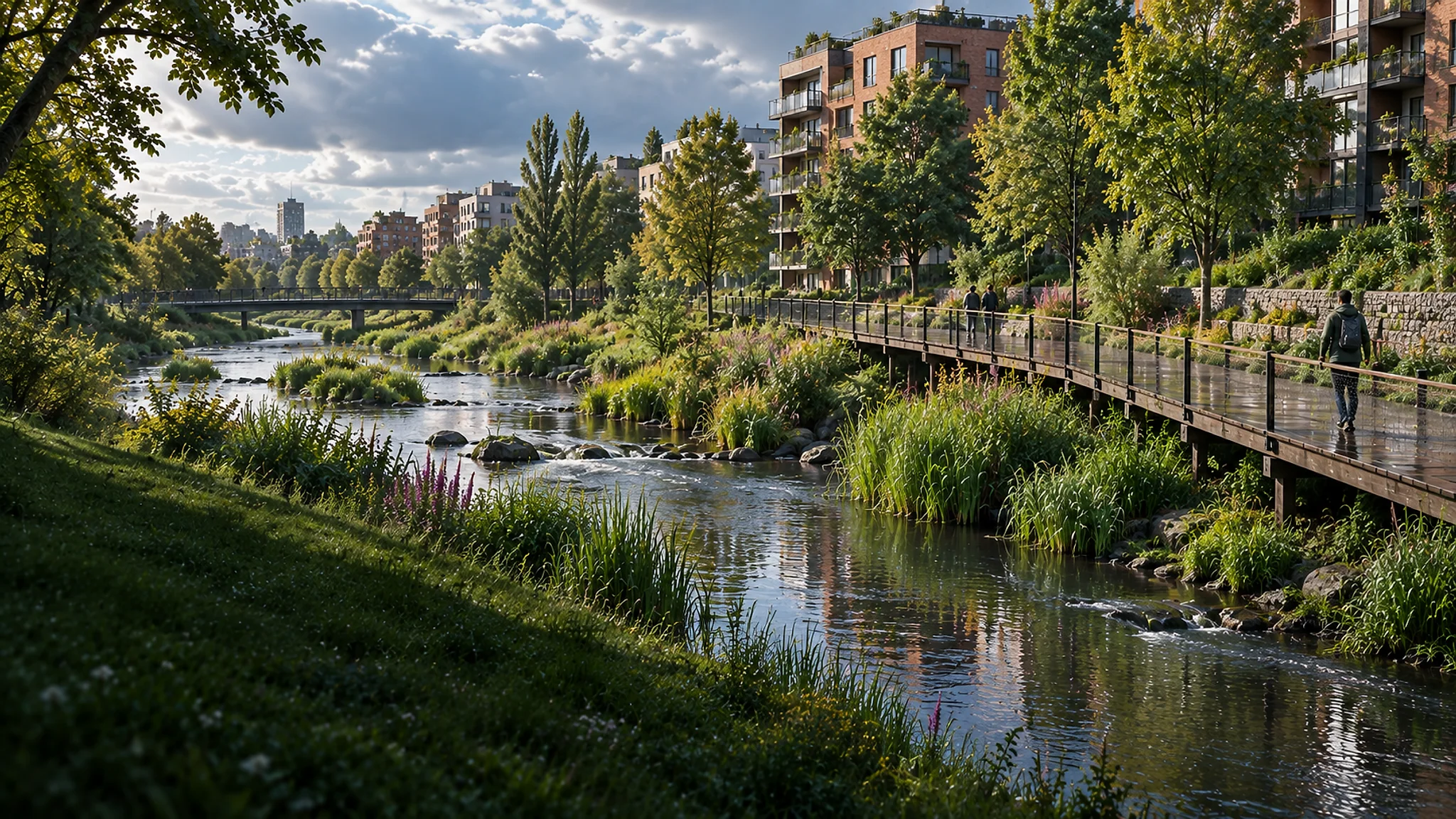
Sustainable urban drainage inverts the logic: retain, infiltrate, delay. Its components are well known and cheap compared with enlarging a trunk sewer: permeable paving in car parks and pavements, continuous tree pits taking runoff from the carriageway, rain gardens on corners, swales, storm tanks and, where possible, daylighting the watercourse culverted decades ago.
Two cases are worth knowing. Copenhagen, after the 2011 cloudburst, designed streets and squares that flood on purpose to protect homes. And China's sponge cities programme has tested the same at large scale with uneven results, because a solution based on infiltration requires ground that infiltrates and constant maintenance that is not always budgeted.
Biodiversity: green is not the same as alive
A watered, mown lawn is green and almost dead: it supports very little life, consumes water and demands energy. Urban biodiversity depends on other things: variety of plant species, presence of native flora, distinct vegetation layers, dead wood, water, and above all continuity between spaces.
This is where Richard Forman's framework is useful. His model of patches, corridors and matrix explains why two isolated parks support far less life than the same two parks joined by a line of trees or a watercourse: small populations go locally extinct and need to be recolonised from outside. Connectivity, not total area, is the limiting factor in most cities.
The measures with the best return per euro are unspectacular: reducing mowing frequency in part of the parks, planting varied native species instead of an ornamental monoculture, leaving dead wood in place, opening gaps in walls and fences for small fauna, switching off or redirecting night lighting, which is a leading cause of insect collapse, and keeping vacant lots with their spontaneous vegetation, which often hold more species than the park next door.
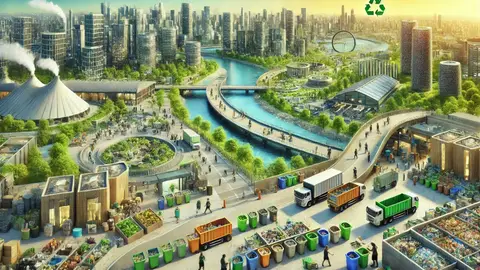
Waste: the invisible infrastructure
Waste management is the worst-funded urban infrastructure relative to its direct health impact, according to the global assessment Daniel Hoornweg led for the World Bank. Its central finding is an uncomfortable correlation: the richer a city, the more waste it generates per head, and the critical problem lies in cities growing rich fast, where generation outpaces collection capacity.
The treatment hierarchy is clear and almost never followed in that order: prevent, reuse, recycle, recover, and only last dispose. What works best in practice are two measures: separate door-to-door collection, which multiplies separation rates compared with street containers, and pay-as-you-throw charging based on what each household discards.
The liveliest argument is incineration. Paul Connett has argued that an incinerator requires waste supply contracts of twenty or thirty years, obliging the municipality to produce rubbish to feed it and removing any incentive to reduce it. His alternative, zero waste, has its European reference case in Capannori, Tuscany. Defenders of energy recovery reply that it is preferable to landfill once recycling is mature.
The problem of green that displaces
This is the best-documented perverse effect in the whole field. When a city restores a river, opens a large park or plants a green corridor, the district becomes more attractive and prices rise, so the residents who went decades without green space end up paying for the benefit in rent, or moving. Jennifer Wolch formulated this precisely and measured the inequality of access to green that the policy set out to correct.
Her proposal is the just green enough rule: modest interventions, spread across the district, made with the people already living there, and without the flagship operation that attracts investment. Many small parks do more for public health than one spectacular park, and they do not produce the same price jump.
The second part of the answer is not landscape but housing: affordable housing reserved within the scheme's area, municipal rights of first refusal over nearby buildings, and tenant protection during the years the works take. Without that, green infrastructure functions as an income transfer from those who needed it to those who can pay for the view.
How to evaluate a city's green
The useful indicators are few and concrete. The 3-30-300 rule, proposed by Cecil Konijnendijk, is the most practical synthesis: see at least three trees from every home, have thirty per cent tree canopy in the neighbourhood, and a quality green space within three hundred metres. It is easy to measure and hard to fake.
To that it is worth adding four figures: the area of permeable soil, the share of mature trees against recent planting, the distribution of green by neighbourhood income, and the annual maintenance budget per tree. That last one says most: a city that plants a lot and maintains little loses half of what it plants within a few years and repeats the photograph every term.
Finally, be wary of aggregate figures for square metres of green per inhabitant. A large peri-urban park reachable only by car inflates the indicator without shading a single pavement, and a district can meet the standard and remain an oven. What matters is walking distance, shade over everyday routes, and who has both.
Frequently asked questions
- What is green infrastructure?
- The network of natural elements in a city — trees, parks, rivers, permeable soils and green roofs — understood as an infrastructure delivering measurable services: shade, drainage, air filtering, biodiversity and public health.
- How many trees should a neighbourhood have?
- The 3-30-300 rule proposes three trees visible from every home, thirty per cent canopy cover in the neighbourhood, and a quality green space within three hundred metres. It is the most practical standard because it can be checked on a map.
- Is it better to plant new trees or keep old ones?
- Keep the old ones. Almost all the service depends on leaf area, so one mature specimen is worth dozens of saplings. Replacing a large tree with a young one is a net loss of service for twenty or thirty years.
- What is green gentrification?
- The process by which an environmental improvement, a park or a restored river, makes a district more expensive and displaces the residents it was meant to benefit. Jennifer Wolch's answer is to intervene modestly and in a spread-out way, alongside housing policy.
- Are green roofs and walls worth it?
- They help, but less than advertised and at high cost: they mostly cool the building itself, require permanent irrigation and maintenance, and contribute little biodiversity. A street tree gives more shade and more service per euro invested.