Key points
- Necessary activities happen anywhere; optional and social ones only where the street invites people to stay.
- Architecture designed for five kilometres an hour holds attention; designed for sixty, it empties the street.
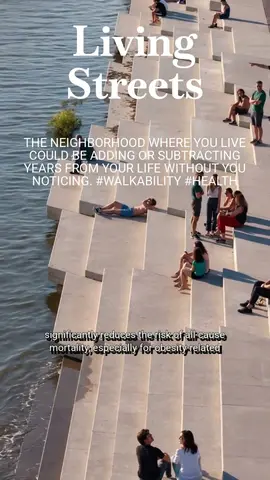
- Copenhagen multiplied by four the people staying in its centre over four decades while car traffic fell.
Walking is the key to a livelier and safer city because every other urban activity, meeting, shopping, playing, watching, waiting, begins with someone on foot who decides to stop. The Danish architect Jan Gehl has spent more than five decades proving that claim with counts rather than opinions. In Life Between Buildings (1971) and Cities for People (2010) he shows that the quality of a street or square is measured not by its paving or its façades but by how many people choose to linger in it, and that a city designed at walking speed produces more public life, more safety and more commerce than one designed for the car.
Necessary, optional and social activities
Gehl's method starts from a distinction. Necessary activities, going to work, catching a bus, happen whatever the environment. Optional activities, sitting in the sun, stopping to talk, letting children play, happen only when conditions are good. And social activities, the encounters between strangers that make a city feel alive, grow out of the optional ones. A street that only serves necessary movement is empty as soon as the errand is done. A street that invites optional activity fills up and stays full. Gehl's teams count who walks, who stops and for how long, and compare the results before and after every intervention.
The five-kilometre-an-hour city: human scale in practice
The human body sets the rules. People walk at about five kilometres an hour, see detail within twenty-five metres and recognise a face at a hundred. Architecture designed for that speed, with doors every few metres, windows at eye level, benches facing the flow and shelter from wind and sun, holds attention and slows people down. Architecture designed for sixty kilometres an hour, long blank walls, wide setbacks, signs legible from a car, bores the pedestrian and hurries them along. Gehl's twelve quality criteria for public space, from protection against traffic to opportunities to sit, see and talk, translate that bodily scale into a checklist.
Why walking makes streets safer
Safety follows from presence. A street with people on it at every hour is watched by hundreds of eyes, the mechanism Jane Jacobs described in 1961 and Gehl confirmed by observation. Traffic safety improves too: where cars share space with many pedestrians and cyclists, drivers slow down, and injuries fall faster than any signal or barrier achieves. Copenhagen, where Gehl advised the gradual pedestrianisation of Strøget from 1962, multiplied the number of people staying in its centre by a factor of four over four decades while car traffic fell, and became one of the safest large cities to walk and cycle in.
Cycling, redistribution of the street and the case of Copenhagen
Cycling extends the same logic. A city that paints a lane but forces every cyclist to negotiate with fast traffic has not made cycling possible; continuity, protection at junctions and priority at lights have. Gehl treats bicycles as the natural companion of walking, because both move at a speed at which the city can be experienced and both need the street to be redistributed away from the car. The choice of widths, speeds and routes tells every citizen who belongs on the street, and that message is the real content of a mobility policy.
The objection is fair: cars meet real needs, and not every street can be a promenade. Gehl's answer is not to ban the car but to stop judging streets only by how many vehicles they move. A city measures what it values. When planners count pedestrians and time spent, as Copenhagen, Melbourne, New York and dozens of other cities now do with Gehl's public life surveys, the street becomes a place to be as well as to pass through, and the result is a city that is livelier, safer and better for business at the same time.
Frequently asked questions
How does walking make a city safer?
Streets with people at every hour are watched by hundreds of eyes, which deters crime, and where many pedestrians and cyclists share space drivers slow down, so injuries fall faster than any signal or barrier achieves.
What are Jan Gehl's twelve quality criteria?
A checklist for public space grouped into protection, from traffic, crime and weather; comfort, opportunities to walk, stand, sit, see, talk and play; and enjoyment, human scale, good climate and sensory quality.